Bangladesh-China
Bangladesh-China education ties to boost partnership, career prospects: Mahdi
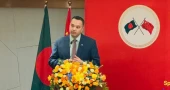
Education ties between Bangladesh and China will strengthen bilateral partnership while creating more employment and career opportunities, Prime Minister’s Education and Primary and Mass Education Adviser Mahdi Amin said Thursday.
“Our plan is to make technical and vocational education compulsory for all to connect theoretical classroom learning with the practical needs of the workplace,” he said.
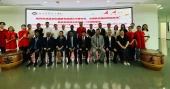
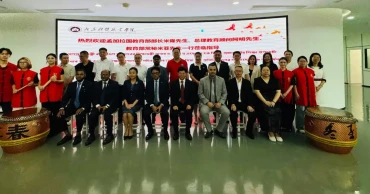
Mahdi Amin made the remarks at a symposium titled “Technical Education Bridging and China-Bangladesh Economic-Trade Talent Development” held in Guangdong, China, Thursday morning.
He said the government under the visionary leadership of Prime Minister Tarique Rahman has made education its highest priority as part of its commitment to taking effective and visible steps to meet people’s expectations and implement its election manifesto.
He also said the government has taken effective steps to make third-language education compulsory, giving priority to Mandarin or Chinese, to help Bangladesh’s large young generation stay ahead in global trade and the international arena.
The symposium was organised to promote cooperation in technical education, technological training, skills development, and the integration of technology and industry with education.
The adviser said stronger bilateral educational exchanges, including teacher cooperation, student scholarships, curriculum development and institutional partnerships, could play an important role in deepening connectivity between Bangladesh and China.
Such cooperation could create employment opportunities, enhance skills and help build a more sustainable and mutually beneficial partnership between the two countries, he said.
Mahdi Amin stressed the importance of bilateral educational connectivity and direct cooperation with reputed Chinese educational institutions for sustainable transformation.
“Developing a skilled generation is essential to sustain the growing economic and trade partnership between Bangladesh and China,” he said.
He said the government’s key objective is to develop human resources proficient in international trade, cross-border e-commerce, supply chain management, financial technology and modern logistics.
“Our plan is to use the experience of reputed Chinese educational institutions to develop a modern and skilled generation capable of directly leading Bangladesh-China bilateral trade, investment and industrial sectors,” he said.
The adviser stressed strengthening institutional ties between teachers and researchers of the two countries.
He said regular faculty collaboration and exchange programmes could help Bangladeshi teachers enhance their capabilities by gaining exposure to China’s modern trade and technological expertise.
The government also plans to significantly increase scholarships and higher education opportunities for Bangladesh’s large young population at leading Chinese universities and technical institutions, he said.
Mahdi Amin said the government has specific plans to redesign technical curricula in line with the practical needs of China’s reputed educational institutions and modern industries, develop internationally recognised courses and ensure joint certification.
It also aims to establish direct institutional partnerships between Bangladeshi polytechnic and technical education institutions and leading Chinese industries and industry partners, he said.
He said the government wants to incorporate the practical needs of Chinese industries into curricula and establish a modern employment exchange network between the two countries.
The objective is to ensure that students can access internships, skills development and decent employment opportunities in domestic and international Chinese industrial zones immediately after completing their studies, he said.
He also outlined a long-term plan to establish modern laboratories and practical training workshops in Bangladesh in areas such as artificial intelligence, robotics, smart manufacturing and emerging technologies.
“Our goal is to build an inclusive education ecosystem where students will not be limited to competition for conventional professions. Instead, they should be able to develop the highest level of skills in the trades they are interested in,” Mahdi Amin said.
He said the government plans to ensure all necessary opportunities and facilities through joint initiatives so that Bangladesh’s large young generation does not face financial barriers in this transformation.
The adviser also called on Chinese industries and educational institutions to make joint investments to expand technical education and strengthen economic ties between the two countries.
He said the government’s ultimate goal is to develop a sustainable framework for future cooperation between Bangladeshi educational institutions and Chinese technical institutions and industry partners.
Under the framework, the government plans to identify specific partners and quickly launch joint projects, modern training and academic programmes, he said.
Mahdi Amin urged reputed Chinese industries and educational institutions to come to Bangladesh and invest in modern laboratories and skills development.
He expressed hope that new investment and educational cooperation with China would help transform Bangladesh’s large and promising young population into a world-class workforce.
Education Minister Dr ANM Ehsanul Haque Milon and Secretary of the Technical and Madrasa Education Division of the Ministry of Education Md Daud Mia were also part of the Bangladesh delegation.
Presidents and representatives of several reputed Chinese educational institutions, prominent teachers and researchers, students and leading Chinese industrial entrepreneurs attended the event.
The Education Minister said Bangladesh has a strong interest in learning from China’s experience in modernising technical education.
Bangladesh’s large young population represents enormous potential, and high-quality technical and vocational education can play a crucial role in turning this potential into a skilled and productive workforce, he said.
He called for greater cooperation between Bangladeshi and Chinese institutions in technical education, modern skills training, curriculum development, institutional partnerships and employment-oriented education.
One of the major highlights of the event was the launch of the Guangdong “Chinese + Vocational Skills” Industry-Education Integration Alliance to promote technical education globally.
The alliance has created a new platform for cooperation in technical education, language education, skills development and industry-education integration.
22 days ago
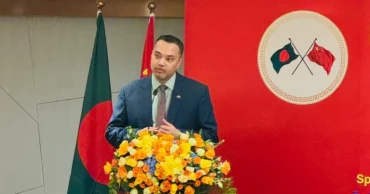
Education can drive Bangladesh-China people-to-people ties: Mahdi Amin
Prime Minister’s Education and Primary and Mass Education Adviser Mahdi Amin on Wednesday said education should become a key driving force in strengthening people-to-people connectivity between Bangladesh and China.
Speaking at a meeting on Bangladesh-China education cooperation in Guangzhou, he called for expanded scholarships, joint research, academic exchanges and stronger cooperation in technical and vocational education between the two countries.
Mahdi said many Chinese universities are now leading in global rankings and scientific research, and Bangladesh wants to benefit from their best practices and advanced research culture, said a press release.
He said Bangladesh is keen to increase scholarship opportunities for talented Bangladeshi students at renowned Chinese universities and undertake joint research projects to improve access to modern laboratories and international academic resources.
The meeting focused on four key areas—study opportunities for Bangladeshi students in China, cooperation between universities, joint research, and technical education and skills development.
Mahdi said Bangladesh’s large working-age population is one of its greatest economic strengths, but the country’s education system has remained overly dependent on theoretical learning for many years.
He said the government is working to make education more practical and employment-oriented and plans to give greater priority to technical and vocational education.
The adviser also said the government is moving to make third-language learning compulsory to help young people compete globally, with Prime Minister Tarique Rahman giving priority to Mandarin.
He stressed the need for stronger industry-academia collaboration and modern employment exchanges to better connect education with the job market.
Mahdi called for regular exchanges of teachers, researchers and students between Bangladesh and China, saying such programmes could create greater opportunities for Bangladeshi students to pursue higher education in China while allowing Chinese students to visit Bangladesh through exchange programmes and summer schools.
23 days ago

Cabinet Committee clears fertiliser import from Russia, China-backed CEIZ deals
The Cabinet Committee on Economic Affairs on Wednesday approved three separate proposals including the import of urea fertiliser from Russia under the direct procurement method and agreements related to a Chinese-backed economic zone in Chattogram.
The approvals came at a meeting of the committee following consideration of proposals submitted by the Industries Ministry and the Prime Minister’s Office.
Finance Minuster Amir Khosru Mahmud Chowdhury chaired the meeting held at Secretariat.
The fertiliser import proposal was placed by the Industries Ministry.
The committee also approved the signing two agreements with Bangladesh CEIZ Company Limited, a Special Purpose Company (SPC) formed for the establishment of the Chinese Economic and Industrial Zone (CEIZ) at Anwara upazila in Chattogram district.
The proposal, submitted by the Prime Minister’s Office, sought approval for the Development Agreement and the Land Lease Agreement to be signed with the company.
The Chinese Economic and Industrial Zone is expected to attract foreign investment, facilitate industrialisation and generate employment opportunities in the region.
The project is considered one of the majoBr angladesh-China economic cooperation initiatives.
The committee also gave nod to another proposal submitted by the Prime Minister’s Office regarding the establishment of a Free Trade Zone.
The proposal concerns approval of the portion recommended by the Bangladesh Economic Zones Authority (BEZA) based on a report submitted by the committee formed to examine matters related to the establishment of a free trade zone.
3 months ago

Chinese firm to invest $22m in fashion and beauty factory in Bangladesh
A Chinese company is set to invest US$22 million to establish a fashion and beauty products manufacturing facility at the Bangladesh Export Processing Zones Authority Economic Zone.
Adeline Beauty Technology (Bangladesh) Co., Ltd. signed a land lease agreement with BEPZA on Wednesday at the BEPZA Complex in Dhaka to set up the factory.
The company plans to invest US$22 million in the project, which is expected to generate employment for approximately 4,170 Bangladeshi nationals.
Under the agreement, Adeline Beauty Technology will manufacture a wide range of fashion hair and beauty products, including wigs, eyelashes and cosmetic nails.
The products will be primarily exported to major international markets such as the United States, Canada, the United Kingdom, Germany, France, Spain, Italy, the United Arab Emirates, Russia and Mexico, among others.
The project is also expected to strengthen Bangladesh’s position in the fast-growing global beauty and personal care sector, which has seen steady demand in North America, Europe and the Middle East in recent years.
The agreement was signed by Md Tanvir Hossain, Executive Director (Investment Promotion) of BEPZA, on behalf of the authority, while Managing Director Hang Sun signed on behalf of Adeline Beauty Technology (Bangladesh) Co., Ltd.
Executive Chairman of BEPZA, Major General Mohammad Moazzem Hossain, witnessed the signing ceremony.
Bangladesh seeks more Chinese investments, security cooperation
Speaking on the occasion, the Executive Chairman thanked the company for choosing BEPZA Economic Zone as its investment destination.
He reaffirmed the authority’s commitment to providing a secure, compliant and business-friendly environment for investors.
6 months ago
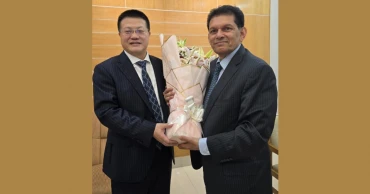
China reaffirms support for Bangladesh’s democratic transition
China’s Ambassador to Bangladesh Yao Wen on Sunday met National Security Adviser Dr Khalilur Rahman and reaffirmed his government’s continued support for Bangladesh’s ongoing democratic transition and conveyed best wishes for the successful conduct of the forthcoming national election.
The meeting was held in a 'cordial and constructive atmosphere' at the Chief Adviser's Office where both sides exchanged views on issues of mutual interest.
They reaffirmed the longstanding friendship and development cooperation between Bangladesh and China.
Discussions included the Teesta River Comprehensive Management and Restoration Project and the proposed Bangladesh-China Friendship Hospital.
In this context, the Chinese Ambassador said he would visit the Teesta project area and reiterated China’s commitment to completing the ongoing technical assessment expeditiously, said the Chief Adviser’s press wing.
Both sides expressed satisfaction with the positive momentum in bilateral relations and reiterated their shared commitment to further strengthening cooperation for mutual benefit.
8 months ago

Bangladesh delegation leaves for China to promote investment opportunities
A high-level delegation led by Ashik Chowdhury, Executive Chairman of the Bangladesh Investment Development Authority (BIDA) and the Bangladesh Economic Zones Authority (BEZA), has left for China to promote and facilitate foreign direct investment.
The delegation includes senior officials from BIDA, BEZA and representatives from the banking sector including HSBC, Standard Chartered Bangladesh, and Citi NA.
BIDA presents final recommendations of National Semiconductor Task Force to CA
“We are pleased to have received considerable interest in our visit. We look forward to engaging with Chinese companies and providing them with the information and support they need to invest in Bangladesh,” said Ashik Chowdhury ahead of the trip.
The delegation will hold a series of engagements in Shanghai and Guangzhou from 20 to 26 July.
A key highlight of the visit will be a business seminar in Shanghai on 21 July jointly organised by BIDA and the Embassy of Bangladesh in China with participation expected from over 100 Chinese investors and companies in sectors such as electronics, textiles, agribusiness, biotechnology, pharmaceuticals, and medical devices.
1 year ago

Bangladesh-China Apon Media Club, DRU to boost media collaboration
In a significant step toward enhancing media cooperation between Bangladesh and China, the Bangladesh-China Apon Media Club and Dhaka Reporters Unity (DRU) signed a Memorandum of Understanding (MoU) on Tuesday at the CMG Bangla Dhaka office.
The MoU was signed by Moinul Hasan Sohel, general secretary of DRU, and Olivia Chu, representative of the Bangladesh-China Apon Media Club, on behalf of their respective organizations.
Welcoming the DRU delegates at the ceremony, Yu Kuang Yue, director of the Bangla Department of CMG, expressed his delight over the agreement.
He emphasised the strong bilateral ties that have developed between the two countries over the past 50 years, noting that the media plays a pivotal role in strengthening these relations. “This MoU will serve as a bridge for further collaboration between Chinese and Bangladeshi media,” he said.
DRU General Secretary Moinul Hasan said the agreement opens up new avenues for cooperation in sectors such as tourism, health, and education. He added that this initiative will contribute to further solidifying economic ties between the two nations.
DRU Vice President Gazi Anwar highlighted the importance of accurate information. “Bangladeshi journalists can now source news about China directly from Chinese media, ensuring factual and authentic reporting. We want to see China through Chinese eyes, not just through foreign outlets,” he said.
South Korean Ambassador seeks enhanced trade and investment in Bangladesh
Joint Secretary of DRU, Nadia Sharmin, emphasised the importance of creating a media bridge between the two nations. “The longstanding relationship between Bangladesh and China needed a dedicated media linkage, and today’s agreement fulfills that need. We hope to walk together on the path of technology and development,” she said.
Other DRU officials present at the event included Organizational Secretary Abdul Hai Tuhin, Women Affairs Secretary Rozina Rozy, and Publicity and Publication Secretary Mizan Chowdhury. Journalists from CMG Bangla’s Dhaka office also attended the ceremony.
During the event, discussions were held on future collaborations including information exchange programs, journalist training, and launching awards for best reporting, aimed at fostering deeper ties and professional development.
The Bangladesh-China Apon Media Club was established in December 2024, while the Dhaka Reporters Unity, founded on May 26, 1995, is currently the largest organisation of reporters in Bangladesh.
1 year ago
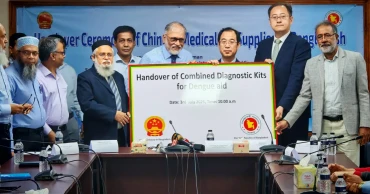
Bangladesh to overcome dengue epidemic with joint efforts, says China
China on Thursday said they firmly believe that the people of Bangladesh will be able to overcome the dengue epidemic soon with the joint efforts of the Bangladesh government, society and support from the international community.
"We sincerely hope that every dengue patient receives the best possible treatment and a speedy recovery," said Chargé d'Affaires of China Embassy in Bangladesh Dr Liu Yuyin while donating dengue prevention materials to Bangladesh.
The Chinese government empathised with Bangladesh’s fight against dengue and has 'acted swiftly' upon the request of the Ministry of Health and Family Welfare.
"Within a very short time, we have procured 789 boxes (over 19,700 units) of Degue Rapid Test Kits worth Tk 5 million," said the Chinese CDA, adding that this assistance stems not only from humanitarian spirit but also from the enduring friendship between our two countries.
"It is yet another vivid example of our comprehensive strategic cooperative partnership in action in the field of public health," he added.
The programme was held at the Directorate General of Health Services (DGHS).
Special Assistant to the Chief Adviser for the Ministry of Health and Family Welfare Prof Dr Md Sayedur Rahman and Director General of DGHS Prof Dr Md Abu Jafor joined the handing over ceremony.
Dengue fever is a global public health concern, and Bangladesh, as a densely populated country with extensive water systems, faces particularly severe challenges in prevention and control, Liu Yuyin said.
US supports Prof Yunus's bid to build consensus on reform agenda for elections
"We highly commend the proactive measures taken by the Government of Bangladesh, including strengthening vector control, improving surveillance systems, and promoting public education," he mentioned.
The CDA China will continue to do its utmost to maintain efficient collaboration with Bangladesh, strongly support the development of its healthcare sector and advance exchanges and cooperation in health to benefit more people in both countries.
On behalf of the Embassy of the People’s Republic of China in Bangladesh, he extended their sincere gratitude to the Ministry of Health and Family Welfare, the Directorate General of Health Services, the Central Medical Stores Depot, the Communicable Disease Control (CDC), and all other stakeholders for their active cooperation and hard work.
He also expressed their highest respect to the medical workers fighting on the frontlines against dengue.
In March this year, Chief Adviser Professor Muhammad Yunus attended the Boao Forum for Asia Annual Conference 2025 and visited Beijing.
This visit released a strong signal of mutual support, understanding and trust between China and Bangladesh, demonstrating that no matter how the international situation or Bangladesh’s domestic situation changes, China’s commitment to deepening the comprehensive strategic cooperative partnership with Bangladesh remains unwavering, said the CDA.
During the visit, Liu Yuyin said the two sides issued a joint statement and reached over ten practical cooperation outcomes, including a series of collaborations in the health sector.
"Today’s ceremony is a concrete step to implement the important consensus reached by our leaders," he said.
As President Xi Jinping emphasised, people’s health is the foundation of social progress, said the CDA.
Bangladesh seeks ICESCO support to establish 'Islamic Culture Centre'
"As a friendly neighbour and trusted development partner of Bangladesh, China has always demonstrated the profound bond of a “friend in need is a friend indeed” through concrete actions," Liu Yuyin said.
Last September, at the invitation of the interim government of Bangladesh, China was the first country to dispatch a national emergency medical team to Dhaka.
The team visited victims injured in the July movement and worked with Bangladeshi counterparts on treatment plans.
"This year, in addition to dengue supplies, we have provided Bangladesh with flood relief materials, robotic physiotherapy equipment, ventilators, and are in the process of delivering mobile medical vehicles and COVID-19 testing kits—totaling more than 3 million USD in value," Liu Yuyin said.
1 year ago
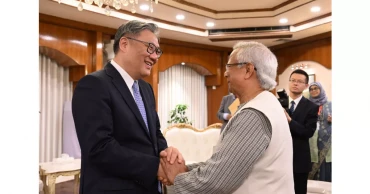
Every village in Bangladesh can become production unit with Chinese touch: Prof Yunus
Chief Adviser Professor Muhammad Yunus on Sunday said there are huge opportunities left unexplored in Bangladesh’s villages, especially in the field of agriculture and in deep water marine and river fisheries.
During his meeting with Chinese Commerce Minister Wang Wentao, the Chief Adviser said every village in Bangladesh could be transformed into a production unit with a Chinese touch.
Minister Wentao said his country is ready to extend cooperation with Bangladesh in trade and commerce, with a particular eye on agriculture, jute, marine fisheries and research.
The Chinese minister, who led a large delegation of Chinese businesspeople and industrialists at the China-Bangladesh Conference on Investment and Trade, made the comments when he met the Chief Adviser at the State Guest House Jamuna in Dhaka.
“The Chinese companies that have come with me are excited. You expressed the direction of Bangladesh’s future development. The Chinese companies told me that they are now more confident about investing in Bangladesh after your initiatives,” Wentao told the Chief Adviser.
Referring to growing consumerism in Bangladesh, the Chinese minister said he was impressed by the presence of shoppers in Bangladeshi malls even after 10pm and cited statistics that suggested that by 2030, Bangladesh would become the ninth largest consumer market in the world.
“As we discussed, we are eager to know what areas of agriculture we can have full-scale cooperation in,” the Chinese minister said, referring to areas such as farmland development, water conservation and planting technologies.
“As I see it, agriculture is not just an industry but a form of social organisation,” the minister said.
Beijing for working together to maintain multilateral trading system, stability
When it comes to fisheries and the marine economy, he mentioned Chinese expertise in the fields and sought specific proposals from Bangladesh.
“China is leading the world in fishing technologies, especially deep water marine fishing,” said the Chinese minister.
He also took note of Professor Yunus’ speech made earlier in the day at the China-Bangladesh Conference on Investment and Trade when the Bangladesh Chief Adviser spoke about the potential of reviving Bangladesh’s jute sector.
He said China imports jute worth $100 million from Bangladesh annually, which is roughly 10 per cent of Bangladesh’s jute exports, and with research and product diversification, this could grow manifold.
He said after the Chief Adviser’s speech at the conference, Chinese jute traders gathered immediately to decide to conduct some research on Bangladesh’s jute products.
“Our cooperation should not be limited to businesses. We should also collaborate on research. If the Bangladesh side joins the research work, I think jute will be a very suitable product for us,” Wentao said.
The Chief Adviser said Bangladesh’s jute product designers can work together with Chinese experts.
He appreciated the Chinese minister’s gesture and thanked China for being on the side of Bangladesh as a friend.
“Your words are music to my ears,” said the Chief Adviser, also hailing the Chinese minister for bringing so many Chinese investors with him and then making a passionate speech about Bangladesh’s prospects at the China-Bangladesh conference earlier in the day.
“We are absolutely delighted. Your speech (today) was really important. So many investors came. It is a good signal for us, as the whole nation is watching,” he said.
CA Prof Yunus invites Chinese firms to invest in Bangladesh
He recalled his recent visit to China when many bilateral issues were discussed, including trade and commerce.
“During our visit, we had a lot of friendly discussions. Your visit will take it forward,” said the Chief Adviser.
Prof Yunus expressed Bangladesh’s willingness to create a favourable environment for Chinese companies to invest and do business in the country.
He voiced hope that China would extend support in developing Bangladesh’s basic industries, particularly agriculture and fisheries, to help improve the livelihoods of its people, according to a statement from the Chinese Ministry of Commerce.
Both sides exchanged views on further deepening practical cooperation between Bangladesh and China.
Chinese Ambassador to Bangladesh Yao Wen also attended the meeting.
Prof Yunus said Bangladesh and China have a profound friendship and China is a trustworthy friend and reliable development partner of Bangladesh.
He thanked China for its long-term support and assistance to Bangladesh's economic and social development, and for arranging a large-scale economic and trade delegation to visit Bangladesh in such a short time after my visit to China and achieving many practical results.
Wentao said China and Bangladesh are good neighbours who help each other and good partners who seek common development.
The leaders of the two countries have drawn up a new blueprint for the development of Bangladesh-China relations.
China is willing to continue to deepen trade and investment cooperation with Bangladesh to achieve common development, said the Chinese side.
China is also willing to follow the important economic and trade consensus reached by the leaders of the two countries and strive to promote pragmatic cooperation with Bangladesh in traditional basic industries such as agriculture and fisheries and emerging fields such as new energy and modern logistics, so as to benefit the people of the two countries and promote the deepening and solidification of the China-Bangladesh comprehensive strategic partnership.
1 year ago
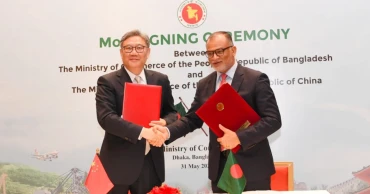
Bangladesh, China sign two MoUs on trade- technological cooptation
Bangladesh and China signed two Memorandums of Understanding (MoUs) on Saturday to bolster trade and technological cooperation.
The MoUs were signed following a bilateral meeting between Commerce Adviser Sk Bashir Uddin and Chinese Commerce Minister Wang Wentao.
The meeting was held at Hotel InterContinental Dhaka, where Adviser Bashir Uddin urged China to support Bangladesh’s agricultural sector by sharing drone technology, emphasising its transformative potential.
“Revolutionary changes can be brought to fertilizer application, seed sowing, pesticide spraying, and crop monitoring through drone technology,” he said, adding that China’s expertise could play a crucial role in modernising Bangladesh’s agriculture.
Minister Wang Wentao responded positively, expressing China’s readiness to expand cooperation in both technology and investment.
Surprise unlikely in upcoming budget: Debapriya
“China is ready to assist Bangladesh in agriculture and digital technology. In particular, we can help to increase productivity through smart agriculture and drone technologies,” he said.
The Bangladesh adviser also sought Chinese support in introducing modern fishing vessels and related technologies to strengthen the country’s marine fisheries sector.
He highlighted the need for advanced trawlers and fish processing systems to tap into Bangladesh’s marine resources effectively.
In reply, Minister Wang reiterated China’s willingness to collaborate in the development of fisheries and marine resources.
“China is prepared to provide the necessary support to Bangladesh in harvesting marine resources and enhancing the fisheries sector,” he noted.
The two sides also discussed broader cooperation in trade, investment and technological advancement.
Of the two MoUs signed during the meeting, one pertains to the formation of a Joint Working Group to promote free trade, while the other focuses on cooperation in the field of e-commerce.
Commerce Adviser Bashir signed on behalf of Bangladesh and Minister Wang Wentao signed on behalf of China.
The Chinese delegation included Yao Wen, Chinese Ambassador to Bangladesh; the Director General of Outward Investment and Economic Cooperation; and the Director General of the Department of Asian Affairs under China’s Ministry of Commerce.
The Bangladeshi side comprised the Commerce Secretary, the Industries Secretary, the Agriculture Secretary, the Chairman of the Bangladesh Trade and Tariff Commission, and other senior officials.
1 year ago