European cities
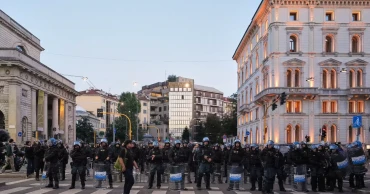
Soldiers guard Milan centre as thousands protest across European cities
Thousands of young people took to the streets of several Italian cities, including Milan, Rome and Turin, on Saturday as authorities deployed large numbers of police and soldiers to prevent a repeat of the violence and looting that marred similar protests last week.
The demonstrations remained largely peaceful in Milan, while brief clashes broke out between protesters and police in Rome and Turin.
In Milan, thousands marched through the streets as soldiers were deployed and luxury shops boarded up their windows. By late afternoon, however, most stores had reopened, Italian media reported.
Prime Minister Giorgia Meloni announced several measures to strengthen security, including deploying an additional 500 soldiers to Milan and imposing tougher penalties on minors. Police said young people made up a large part of the protesters involved in last week's violence. Authorities in Milan also detained several minors as a preventive measure, according to media reports.
Although protests in France have drawn much international attention, large demonstrations also took place on Saturday in several European cities, including Milan, Rome, Madrid, Lisbon and Tirana.
The protests covered a wide range of issues, including education, corruption, anti-war demands, pensions and housing affordability.
Soldiers deployed as Milan braces for unrestAs night fell, large crowds of mostly young people gathered in Milan, chanting slogans against Meloni and holding banners reading, "No to lies of the state."
Some protesters dumped manure outside Italy's energy regulator and burned an oversized electricity bill as a symbolic protest, according to footage broadcast on local television.
The additional 500 soldiers deployed to Milan joined hundreds already stationed in the city. They supported around 5,000 police officers and other security personnel. Authorities also introduced drone surveillance, railway station checks, rapid-response units and online monitoring to identify potential calls for violence.
Pierfrancesco Majorino, a mayoral hopeful who announced his candidacy on Thursday, joined the march and noted how peaceful the demonstration had been, Italian media reported. He plans to contest a centre-left primary in early 2027.
Milan's centre-left Mayor Giuseppe Sala, who has held office since 2016, will not seek another term.
Many shops, particularly luxury boutiques in the city's fashion district, boarded up their windows ahead of the demonstrations. The affected stores included Omega, Tiffany and Gucci. The Apple store also closed and remained shut even after other businesses reopened.
Last weekend, rioters broke into shops and looted goods, particularly sneakers, sportswear and sporting equipment, along streets leading off the city's central Duomo square.
Security measures were extended beyond the city centre amid concerns that unrest could spread to other neighbourhoods.
The protesters ended their march peacefully on Saturday evening outside Milan Polytechnic, more than three kilometres from the city centre.
Authorities said they were investigating a 30-year-old freelance journalist suspected of being the "mastermind" behind the newly formed Oct. 17 movement, which has played a leading role in the recent protests in Italy.
Milan police said around 2,000 very young protesters were involved in last week's violence and looting. Many were described as "naturalized, second-generation Italians", alongside foreign nationals. Police arrested 45 people over two days, including 34 minors.
A group of around 30 far-right activists, described as hooligans linked to Inter Milan football club, briefly appeared at the demonstrations, chanting anti-immigrant and anti-Muslim slogans. Police kept the group isolated from the other protesters.
Defence Minister Guido Crosetto said soldiers deployed on Saturday had only recently been authorised to use plastic restraint ties, and only in areas around railway stations rather than throughout the city. They are not permitted to carry pepper spray or tasers, he added.
Protesters attempt to enter Rome's ColosseumAuthorities also tightened security in Rome, closing off luxury shopping streets and increasing patrols around the Circus Maximus and Piazza del Popolo.
A small group of protesters attempted to force their way into the Colosseum but were escorted out by guards. Elsewhere, several hundred students demonstrated peacefully, stressing that they should not be associated with those responsible for the violence.
"The images from last week were truly something terrible, especially for the young people, for the students, for the vast majority of the younger generations who want to study ... and do not accept being represented by those who use issues and needs to devastate entire cities," said Riccardo Ponzio, national president of an Italian far-right student association.
A separate anti-war march took place in central Rome. Organisers sought to distance their demonstration from potential unrest, urging participants to keep their faces uncovered and their hands visible.
However, the anti-war protesters were involved in brief clashes with police near Piazza della Repubblica. Organisers tried to hold back the crowd using batons and tear gas, but tensions escalated.
The protesters eventually retreated after police deployed a water cannon, moving to a location about half a kilometre away.
Clashes and fires in AlbaniaIn Tirana, the capital of Albania, riot police used water cannons against large groups of protesters on Saturday. Some demonstrators set government buildings on fire and threw objects at police.
Authorities deployed 2,500 officers across the city to maintain order.
For more than a week, protesters have thrown rocks, flares, firebombs and fireworks at police, who have responded with batons and tear gas during clashes in the city centre.
High school and university students are demanding lower tuition fees, increased government investment in education and action against corruption in the education system.
Some have also joined a broader anti-government movement calling for the resignation of Socialist Prime Minister Edi Rama.
Earlier, a separate opposition-organised protest outside the prime minister's office turned violent, with some activists setting fires in the street.
Rama said on Saturday that his government was preparing a response to the students' demands and invited them to talks. He warned that those involved in violence would face penalties.
Pension concerns and housing costs fuel protestsIn Madrid, thousands of retirees and other demonstrators marched peacefully on Saturday, demanding that public pensions be protected from changes.
"They are threatening us with privatizing pensions. It's just another thing they want to profit from," said Maria José Benito, 68.
The demonstration came ahead of next month's snap election, as Prime Minister Pedro Sánchez's Socialist Party criticised the conservative Popular Party for making proposals that it said could lead to the privatisation of public pensions.
Spain has also experienced protests over housing affordability this autumn, as rental and property prices have risen beyond the reach of many residents in recent years.
Inspired by the demonstrations in Spain, protesters demanding affordable housing marched through Lisbon on Saturday.
They also criticised recent measures announced by the government of Portuguese Prime Minister Luis Montenegro, including plans to ease restrictions on annual rent increases and make it easier to evict tenants who fail to pay rent.
Montenegro has defended the measures, saying they are intended to strengthen trust between landlords and tenants and encourage growth in the rental market.
Protesters, however, argue that the changes are unfair and leave tenants more vulnerable.
2 hours ago

Russia, US hold working dinner to open Geneva talks
A top Russian diplomat predicted “difficult” talks with the United States this week after attending a working dinner with U.S. officials in Geneva on Sunday as part of the kickoff to a string of meetings in three European cities this week, with ties at a low over Russia’s military buildup near Ukraine.
Russian Deputy Foreign Minister Sergei Ryabkov and other Russian officials met for over two hours with U.S. Deputy Secretary of State Wendy Sherman, the head of the U.S. delegation, and her team at the luxury residence of the U.S. ambassador to the Conference on Disarmament that overlooks Lake Geneva.
The dinner was a prelude to a broader discussion between the two teams at the U.S. mission in Geneva starting Monday — culminating a string of meetings both virtual and in person among U.S. officials, their Western allies, and Russian leaders in recent days and weeks as tensions over Russian pressure against Ukraine have grown.
Read: Kazakhstan adds uncertainty to talks with Russia on Ukraine
“We plunged into the substance of the forthcoming issues, but the talks are going to be difficult," Ryabkov told reporters as he left the dinner meeting. "They cannot be easy. They will be business-like. I think we won’t waste our time tomorrow.”
State Department spokesman Ned Price said that during Sunday's dinner Sherman “stressed the United States’ commitment to the international principles of sovereignty, territorial integrity, and the freedom of sovereign nations to choose their own alliances," a reference to Ukraine and its aspirations of joining NATO.
Sherman “affirmed that the United States would welcome genuine progress through diplomacy,” Price said in a statement.
The talks are seen a first step toward rekindling dialogue as ties have worsened because Russia has deployed an estimated 100,000 troops along its border with Ukraine. Concerns have risen about a broader Russian military incursion in the country.
Russian President Vladimir Putin's government has laid out a list of demands, such as seeking guarantees that the NATO military alliance won't seek to expand any further eastward to countries like Ukraine or Georgia, which are former Soviet republics.
“The Russian side came here with a clear position that contains a number of elements that, to my mind, are understandable and have been so clearly formulated — including at a high level — that deviating from our approaches simply is not possible," Ryabkov said.
Asked whether Russia was ready for compromise, he said: “The Americans should get ready to reach a compromise."
U.S. Secretary of State Antony Blinken told ABC's "This Week” on Sunday he didn't expect any breakthroughs in talks with the Russians in Geneva or during conversations in Brussels, at a meeting of the NATO-Russia Council, and at the Organization for Cooperation and Security in Europe in Vienna later this week.
The United States and other Western allies have pledged “severe costs” to Russia if it moves against Ukraine.
“The question really now is whether President Putin will take the path of diplomacy and dialogue or seeks confrontation," Blinken said, suggesting that a Russian move deeper into Ukraine might run counter to Moscow's interests in the long run.
“If Russia commits renewed aggression against Ukraine, I think it’s a very fair prospect that NATO will reinforce its positions along its eastern flank, the countries that border Russia,” he told ABC.
Russia was coming into the talks seeking a clearer understanding of the U.S. position, and cited signals from Washington that some of the Russian proposals can be discussed, Ryabkov said earlier Sunday, according to state news agency Tass.
Read:Biden vows US to act decisively if Russia invades Ukraine
He laid out Russia’s three demands: no further NATO expansion, no missiles on Russia’s borders, and for NATO no longer to have military exercises, intelligence operations or infrastructure outside of its 1997 borders.
U.S. officials expressed openness Saturday to discussions on curtailing possible future deployments of offensive missiles in Ukraine and putting limits on American and NATO military exercises in Eastern Europe — if Russia is willing to back off on Ukraine.
But they warned of hard economic sanctions in case of a Russian intervention, including direct sanctions on Russian entities and restrictions on products exported from the U.S. to Russia.
Ambassador Thomas Greminger, director of the Swiss government-supported Geneva Center for Security Policy who hosted Ryabkov for a conference in October, said the Geneva talks were "an opportunity to spell out mutual concerns, to spell out mutual expectations. But it would be way too early to expect any clarity, for instance, regarding Ukraine’s bid for NATO membership.
“What we’re seeing is a lot of posturing," added Greminger, who is also a former head of the OSCE. "I think at the end, both Putin and (U.S. President Joe) Biden have absolutely no interest to push towards an escalation.”
4 years ago