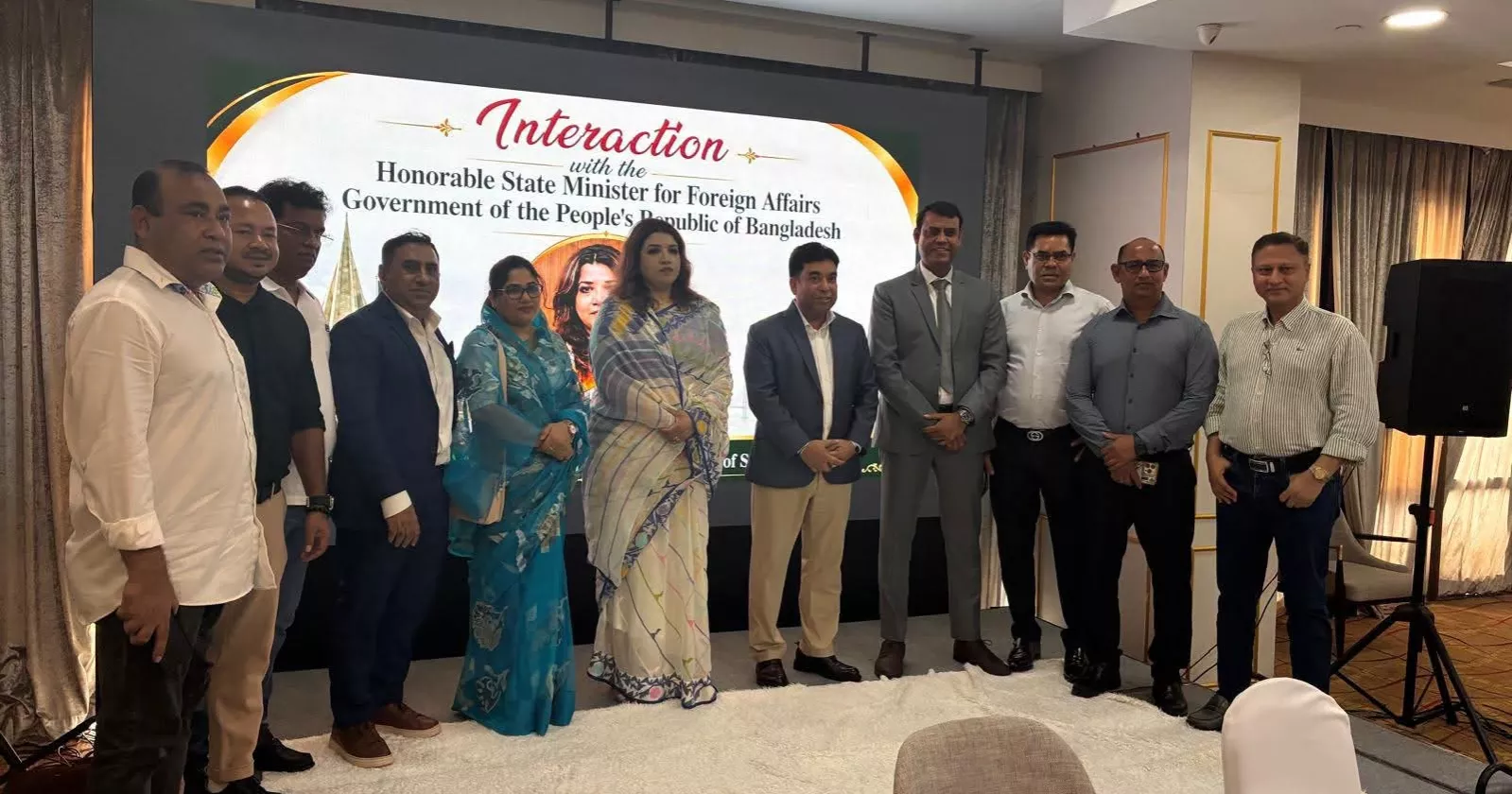
State Minister for Foreign Affairs Shama Obaed Islam has emphasised the importance of economic diplomacy in expanding trade and attracting investment, saying the government has been working to create a more investment-friendly environment in Bangladesh.
"Bangladesh is open for investment from all over the globe," she said, encouraging Bangladeshi businesspeople abroad to explore investment opportunities in the country.
Shama Obaed said Singapore, as a major global business hub, had significant potential to invest in Bangladesh and contribute to employment generation.
The State Minister made the remarks while exchanging views with Bangladeshi businesspeople and professionals in Singapore on Monday.
The event was organised by the Bangladesh Chamber of Singapore. Members of the Bangladesh business community, professionals and migrant workers attended the event, said the Ministry of Foreign Affairs.
At the outset, businesspeople and entrepreneurs from the Chamber briefed the State Minister on their ongoing businesses, opportunities and challenges.
They also focused on expanding trade, commerce and investment opportunities, promoting skilled and unskilled migration, and further strengthening Bangladesh-Singapore economic relations.
The President of the Bangladesh Business Chamber of Singapore briefed the State Minister on the organisation's activities.
He highlighted the Chamber's role in promoting business relations and facilitating exchanges and visits between Bangladesh and Singapore.
The State Minister informed the participants that the Cabinet had recently approved a bill related to investment in Bangladesh.
She said a separate wing had been created in the Foreign Ministry to coordinate with relevant stakeholders in the government and private sectors to resolve issues related to manpower migration, trade, commerce and investment.
Shama Obaed mentioned initiatives in renewable energy, artificial intelligence, technology, pharmaceuticals, ICT, education and Technical and Vocational Education and Training (TVET).
She said Bangladesh has a trade deficit with Singapore and stressed the need to diversify exports to the country.
The State Minister also emphasised the importance of research, innovation and appropriate policy support for developing new export sectors.
Referring to the jute sector, she said jute and jute-based products could be lucrative commodities to trade in a market like Singapore.
She also urged the establishment of a joint Bangladesh-Singapore Chamber comprising businesspeople, entrepreneurs and investors from both countries.
She said the joint chamber could play a crucial role in promoting trade and investment and further expanding business cooperation between Bangladesh and Singapore.
Members of the business community shared a number of proposals, identifying data centres as a potential area for investment in Bangladesh.
They also highlighted the potential benefits of a Free Trade Agreement (FTA) between Bangladesh and Singapore.
The business representatives said Bangladeshi companies in the steel, shipbuilding and ship recycling sectors could benefit from duty-free access to the Singapore market under an FTA.
They proposed organising roadshows to showcase Bangladeshi products in Singapore.
They also suggested establishing a one-stop service for Singaporean investors, simplifying the process of opening bank accounts, organising business workshops and arranging trade fairs.
Representatives from a wide range of professions also attended the session.
They included doctors, engineers, shipbuilding workers, service sector employees, logistics and transport workers, construction workers and IT professionals.
The participants identified elderly caregiving as a promising sector for future employment opportunities for Bangladeshi workers in Singapore.
They suggested that a bilateral agreement could help develop cooperation in this area.
They also proposed arranging some treatment in Bangladesh at a much lower cost than in Singapore and initiating cooperation between hospitals in Bangladesh and Singapore under a government-to-government (G2G) framework.
The participants raised concerns about the high costs faced by aspiring migrant workers, saying exploitation by some recruiting agencies was responsible for the high migration costs in Singapore.
They suggested engaging former migrant workers as trainers at training centres in Bangladesh and introducing affordable training courses for work permit holders in Singapore.
The State Minister assured them that the government has been working to bring the recruitment process under a transparent system to reduce exploitation and migration costs.
The participants also called for diversification of Bangladesh's overseas employment market.
They suggested reducing dependence on traditional sectors such as construction and logistics and exploring areas such as IT, data analysis, cybersecurity and artificial intelligence.
They said Singapore's service sectors offer significant opportunities for skilled foreign professionals.
Responding to the proposals, the State Minister said the government is reviewing opportunities in the TVET sector.
She said the government is continuing discussions with relevant ministries and stakeholders to expand employment opportunities for Bangladeshi workers.
The two interaction sessions provided a platform for direct engagement with the business community and Bangladeshi professionals, including migrant workers, in Singapore.
The discussions focused on expanding investment and trade, increasing skilled employment opportunities, improving migration governance and further strengthening the economic partnership between Bangladesh and Singapore.
Following the discussions, the State Minister requested the participants to formally submit their proposals in writing so that appropriate measures could be taken involving relevant ministries and government organisations to address the challenges.
She assured that the government is committed to working for the betterment of expatriate Bangladeshis living around the world, including Singapore.