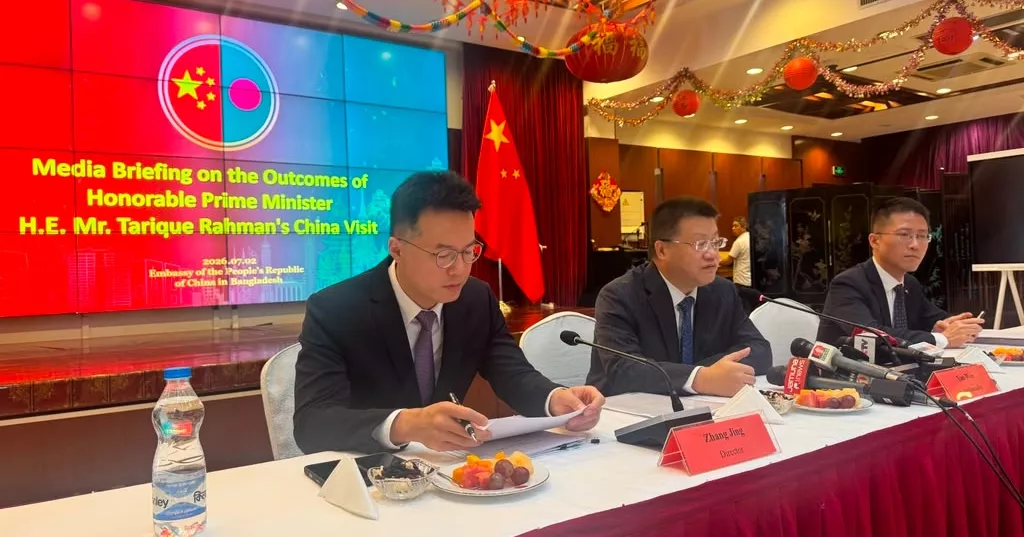
Highlighting the importance of regional connectivity, Chinese Ambassador to Bangladesh Yao Wen on Thursday said China is determined to build an economic corridor with Bangladesh and Myanmar, stressing that the game is not end here and they remain open to other countries to join.
“This cooperation is not the end of the game. We are open, and we welcome other countries if they are ready (to join). But it is up to them to decide whether they want to be part of it or whether they prefer to wait and see. China is determined to work with Bangladesh and Myanmar to build the economic corridor,” he said while responding to a question during a media briefing at the Embassy of China.
Ambassador Yao made the remarks when his attention was drawn to a corridor originally conceived in 1999 as the Bangladesh-China-India-Myanmar (BCIM) Economic Corridor under the BCIM Forum.
“I believe Myanmar also wants to have this sort of cooperation and our three countries can construct this connectivity (economic corridor).”
The two sides, during the just-concluded visit of Prime Minister Tarique Rahman to China, discussed proposals to strengthen regional connectivity, particularly multimodal transport links from Kunming to Bangladeshi ports, as well as China’s proposal for the China-Bangladesh-Myanmar Economic Corridor.
Responding to a question, Ambassador Yao said the issue of building an Economic Corridor is not new and there were discussions on Bangladesh-China-India-Myanmar (BCIM) Economic Corridor but there had been no progress.
Director at the Embassy Zhang Jing and Counselor Song Yang were also present at the media briefing that described the visit as a "complete success."
"It's a complete success. It's a milestone in Bangladesh-China relations which reached a new strategic height," said the Ambassador.
“The visit has injected strong momentum into the future development of China-Bangladesh relations. The visit was a complete success. It is a milestone in the history of China-Bangladesh relations,” he said.
The Ambassador said a new level of trust developed between the two countries with this visit and described the proposed Bangladesh-Myanmar China Economic Corridor as a new strategic opportunity.
The two sides also agreed to explore new options for regional connectivity, including direct connectivity between Bangladesh and China, and the development of the China-Myanmar-Bangladesh Economic Corridor.
“We believe these initiatives will open up new strategic opportunities for Bangladesh's economic development,” the envoy said.
Teesta: Most Closely Watched Issue
Ambassador Yao said the Teesta River Comprehensive Management and Restoration Project (TRCMRP) was highlighted during the visit as livelihoods of millions of people are involved. "Teesta is a Bangladesh project. It's your project," he added.
The envoy said the Teesta project has been one of the most closely watched issues. “During the visit, the Prime Minister met with Chinese Minister of Water Resources Li Guoying. The two sides had in-depth exchanges on water resources cooperation.”
Ambassador Yao said China is ready to strengthen practical cooperation with Bangladesh in water resources planning, river management, flood prevention and disaster reduction.
“We will also enhance capacity building and personnel training in the water sector. Let me make one point very clear. China's commitment to the Teesta river project remains unchanged,” he said.
The envoy said China will continue to provide support and assistance within its capacity for the Teesta project and support experts from both countries in expediting the feasibility study and related work.
He also talked about the key achievements of the Prime Minister's visit to China - the launch of a strategic dialogue at the foreign minister level and the exploration of a "2+2" dialogue mechanism covering diplomacy and defence.
Talking about defence cooperation, Ambassador Yao said Bangladesh-China cooperation is comprehensive and the defence cooperation is part of that. He declined to make comments on any specific defence purchase.
“We also agreed to establish a strategic dialogue mechanism between the two foreign ministers and explore a "2+2" dialogue mechanism on diplomacy and defense,” he said, noting that these arrangements will provide a stronger and more stable platform for strategic communication between the two countries.
The two sides agreed to maintain the momentum of high-level exchanges, enhance mutual learning on governance, and strengthen cooperation between governments, legislative bodies and political parties.
The Ambassador said China has all along attached great importance to the development of Bangladesh-China relations and stayed true to the policy of good-neighborliness and friendship toward all the people of Bangladesh.
“No matter how the world changes, China will not waver in its commitment to the overall direction of China-Bangladesh friendly relations, and will always be a trustworthy good friend, good neighbor and good partner of Bangladesh,” said the Chinese envoy.
He said China welcomes Bangladesh's participation in the group of friends of the Global Development Initiative (GDI) and stands ready to work with Bangladesh to advance the MoU on promoting the implementation of the GDI.
The GDI focuses on humanity’s shared development needs, aligns closely with the United Nations 2030 Agenda for Sustainable Development, and addresses key global development challenges.
Reaching a New Strategic Height
Ambassador Yao said the most significant outcome of the visit was the decision by the two sides to elevate the Bangladesh-China Comprehensive Strategic Cooperative Partnership to jointly build a ‘China-Bangladesh Community with a Shared Future in the New Era.’
He said this represents the highest level of China's relations with its friendly neighbors in Asia.
This was the Prime Minister's first visit to China since taking office. It was also the first formal meeting between the leaders of the two countries since the formation of Bangladesh's new government.
“The leaders of the two countries had candid and productive discussions. They reached important new consensus and sent a clear message of stronger communication, deeper mutual trust and closer cooperation,” said Ambassador Yao.
He said the visit has opened a new chapter in Bangladesh-China friendship. “As our two countries embark on the next golden fifty years of bilateral relations, China stands ready to work with Bangladesh to fully implement the important consensus reached by our leaders and the outcomes of the visit.”
Together, the envoy said, they will translate these outcomes into tangible results and stronger momentum for economic and social development, bringing greater benefits to our two countries and our two peoples.
Bangladesh and China signed 17 bilateral instruments, including MoUs, agreements, a joint action plan, and an agricultural trade protocol, to further strengthen bilateral relations.
The two sides signed an MoU on promoting the implementation of the Global Development Initiative (GDI).
Another MoU on exchanges and cooperation between the Bangladesh Nationalist Party (BNP) and the Communist Party of China was also signed.