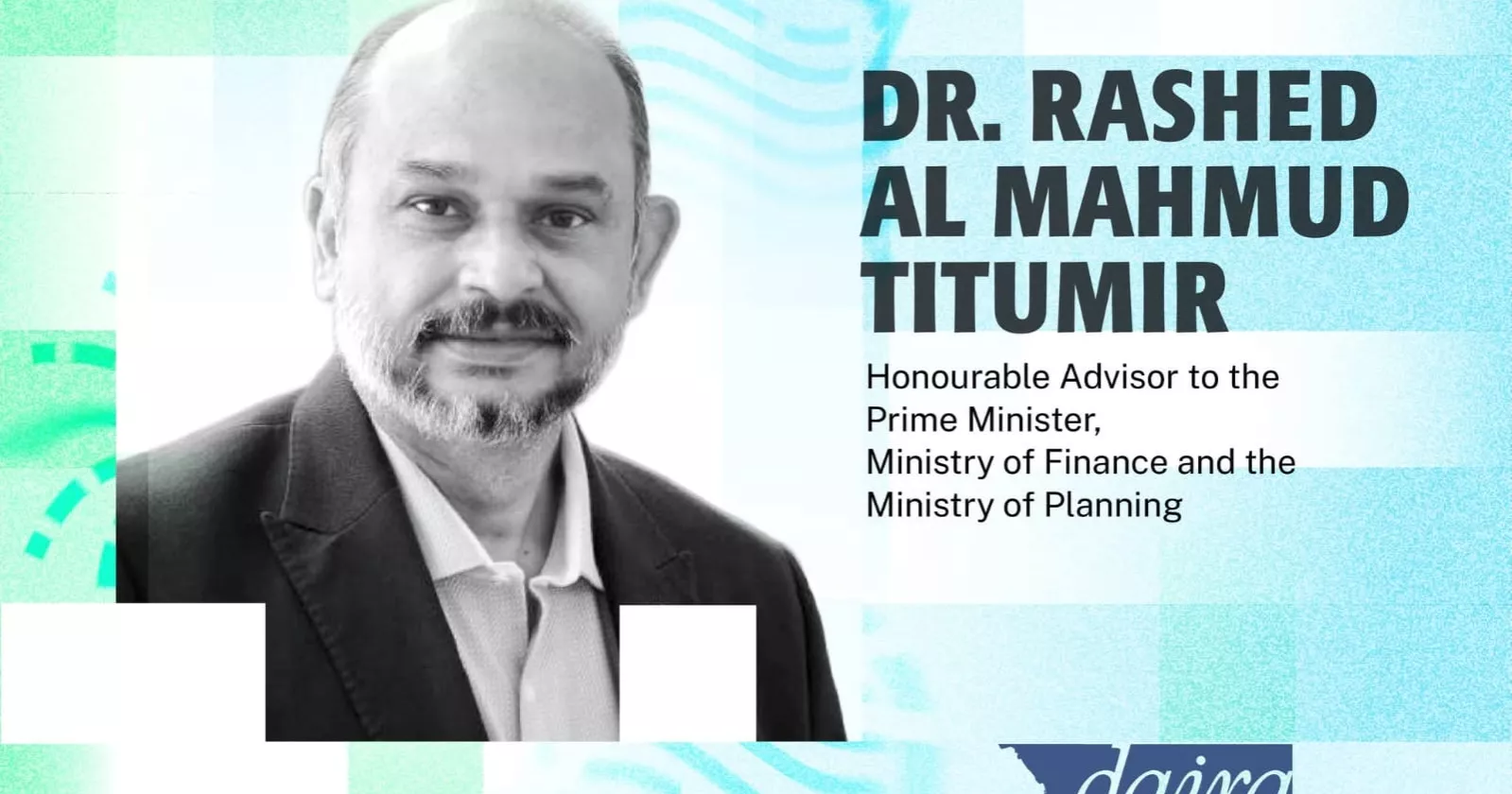
Outlining the government's economic strategy, Prime Minister's Finance and Planning Adviser Dr Rashed Al Mahmud Titumir on Friday said Bangladesh needs an investment-driven development model tailored to domestic realities and changing global geoeconomic conditions.
"We need to pursue a model where investment leads to production, production creates employment, employment increases revenue without raising tax rates, and that revenue finances education, health and social security," he said.
The economist made the remarks during a session at the Bengal Delta Conference 2026 (BDC 2026) moderated by Mushtaq Khan, a Professor of Economics at SOAS University of London.
The Bengal Delta Conference 2026 (BDC 2026), themed “Bangladesh and a Changing World: Uncharted Times, Emerging Orders, and The Politics of Care,” comes at a moment of transition for both Bangladesh and the global order
Dr Titumir reiterated the government's goal of gradually increasing spending on education, healthcare and social protection while moving towards a democratic welfare state.
The Adviser said the government is working to introduce a universal lifecycle-based social security system to protect vulnerable people from falling into poverty during economic shocks.
He also stressed reforms in education and healthcare, saying the focus would be on skills development, citizenship education, innovation and building a national health system reaching grassroots communities.
Highlighting governance reforms, Dr Titumir said legitimacy, accountability and transparency are central to the government's approach.
"If you have a government with legitimacy, you have accountability," he said, adding, "The delivery is about legitimacy. The delivery is accountability. The delivery is transparency."
He said the government inherited a fragile fiscal situation but now has both the political mandate and responsibility to pursue transformative reforms.
"We all are aware of what we inherited. The fiscal condition we inherited was fragile," he said. "There is an overwhelming majority in Parliament, which means that we have more responsibility, and we have to have a transformative change."
Responding to questions on revenue mobilisation, Dr Titumir said the government is prioritising institutional reforms over higher tax rates.
"The equation that the current government is working on has two additional elements which were ignored for years - the constant and the error term," he said, explaining that the "constant" represents institutional strength while the "error term" includes corruption, rent-seeking and tax exemptions.
He said reducing leakages and improving enforcement had already produced encouraging results.
"For the first time in the history of Bangladesh, Chattogram Customs House made a huge contribution," he said, adding that three task forces had been formed to strengthen revenue collection.
Acknowledging existing challenges, Dr Titumir said the government is not claiming to have solved every problem.
"We are not fully equipped yet to deal with tax evasion. That requires capabilities," he said.
On the financial sector, he said authorities are addressing long-standing issues, including non-performing loans and bank recapitalisation.
"We are not hiding anything under the carpet. We are aware of the issues, and we are dealing with them," he said.
Dr Titumir said the government is committed to ending what he described as the "auction market" for Statutory Regulatory Orders (SROs), strengthening accountability and pursuing a production-led economic model to achieve sustainable growth.
"We have inherited what is known as an auction market for SROs. If you are powerful, you get an issuance of an SRO, and you get all those resources," Titumir said while outlining the government's reform agenda.
Referring to tax concessions granted in the past, he said, "These arbitrary concessions, we are working on them, and we are making sure that this SRO culture is not there."
The adviser said decisions on taxation and public expenditure must be guided by Parliament rather than discretionary executive actions.
"It is the sovereign Parliament that would decide where and how the money would be collected and where the money would be spent. This is the key essence of the reform of the government," he said.
Calling industrialisation critical for long-term resilience, Dr Titumir said Bangladesh has revived discussions on industrial policy after years of neglect.
"Industrial policy is back in Bangladesh," he said, adding that expanding productive capacity, ensuring energy security, improving competitiveness and diversifying exports would be essential as the country prepares for graduation from the Least Developed Country (LDC) category in 2029.
Expressing optimism about the government's reform agenda, Titumir said the administration expects to deliver tangible results during the current fiscal year.
"This fiscal year, you would get the early harvest," he said. "We are hopeful that Bangladesh, what we have promised, we would deliver."
Referring to external economic pressures, he said Bangladesh had to spend about $3.46 billion to absorb the impact of the Middle East crisis and global energy price shocks despite having no role in creating those challenges.
"We had to spend $3.46 billion for nothing to do with us," he said, noting that the government had to balance fiscal management with protecting agriculture and consumers from higher fuel costs.