As the United States prepares to mark its 250th Independence Day anniversary, competing visions of the celebration are emerging, with President Donald Trump once again positioned at the center of the national spotlight.
Inside the Smithsonian’s National Museum of American History, exhibits already reflect the country’s divided political and cultural journey. A display titled “In Pursuit of Life, Liberty and Happiness” features contrasting symbols of American life — from Nancy Pelosi’s historic speaker’s gavel and a “Make America Great Again” cap, to an AIDS activism shirt reading “Silence = Death” placed alongside campaign memorabilia from President Ronald Reagan.
Museum officials say the collection is meant to show both unity and division in U.S. history.
“These contestations often reflect resilience and hope,” said museum director Anthea M. Hartig, noting that American history has repeatedly moved through moments of deep division before rebuilding.
Competing visions for the 250th anniversary
That idea of unity is now being tested as preparations intensify for the 250th anniversary celebrations. Two main organizing groups have emerged — Freedom 250, which is aligned with the White House, and America 250, a bipartisan commission created by Congress.
The parallel efforts have fueled concerns that even a milestone national celebration is becoming politically divided.
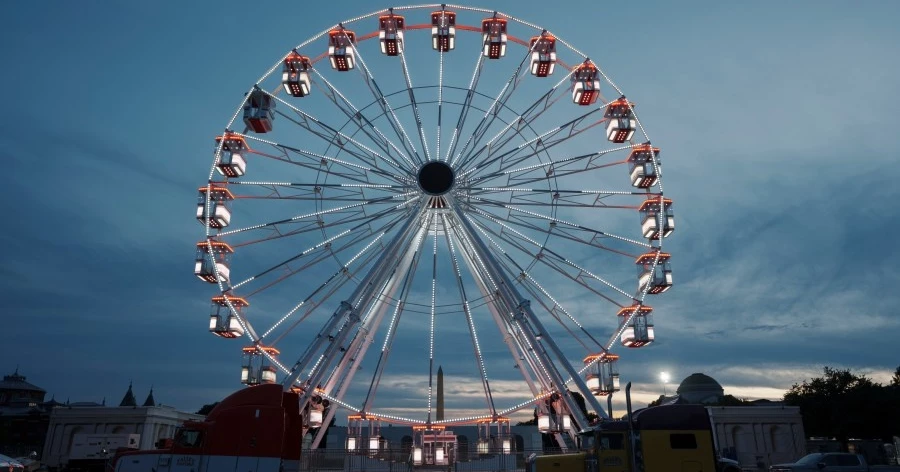
On the National Mall, preparations are underway for an event called “The Great American State Fair.” Several performers, including country singer Martina McBride, have withdrawn from the lineup, saying they were not aware of the political nature of the event. Trump is scheduled to speak at the event on Wednesday.
The split will continue into July Fourth, when America 250 plans a major concert in Los Angeles featuring artists including Chris Stapleton and The Smashing Pumpkins, hosted by Queen Latifah. On the same day, Trump is expected to hold a separate event on the National Mall that he has described as a “Trump rally.”
A break from past presidential traditions
Past U.S. presidents have used Independence Day milestones to emphasize unity rather than political identity. In 1976, President Gerald Ford spoke at Independence Hall in Philadelphia during the bicentennial celebrations, calling liberty a continuing national effort. In 1986, President Ronald Reagan marked the Statue of Liberty’s centennial in New York Harbor, joking that he would not try to compete with fireworks while highlighting shared national history.
Trump’s personal imprint on events
Trump, however, has often placed himself at the center of national cultural and political moments. He became the first sitting president to host the Kennedy Center Honors after a board aligned with him appointed him chairman. His name was also briefly added to the venue’s building before a court ruled the move unlawful.
In Washington, Trump has overseen or supported several major changes, including demolition of the White House East Wing for a proposed ballroom and plans for a triumphal arch near Arlington National Cemetery. He has also hosted events such as a UFC fight at the White House.
“Trump is putting himself at the center of the story,” said presidential historian Mark Updegrove. “He does not see himself as a steward of the presidency. He sees himself as its embodiment.”
Public mood and national divisions
Public sentiment in the U.S. appears subdued ahead of the anniversary. A recent AP-NORC poll found that only about one-quarter of Americans believe the United States stands above all other countries, while around 30% say other nations are better — a notable increase compared to 2016.
The survey also shows declining confidence in democratic identity, with fewer Americans now describing a democratically elected government as “extremely” or “very” important to national identity compared to previous years.
Growing competition over national celebrations
The divided national mood has contributed to a rise in competing cultural and political events. Even major shared moments such as the Super Bowl halftime show have faced parallel or alternative programming following political disagreements.
Organizers of Freedom 250 say their goal is to create “a unifying movement across all 50 states,” while America 250 officials say they welcome multiple celebrations.
“The more celebrations, the merrier,” said America 250 chair Rosie Rios. “We can’t be all things to all Americans, but we want something for everyone.”