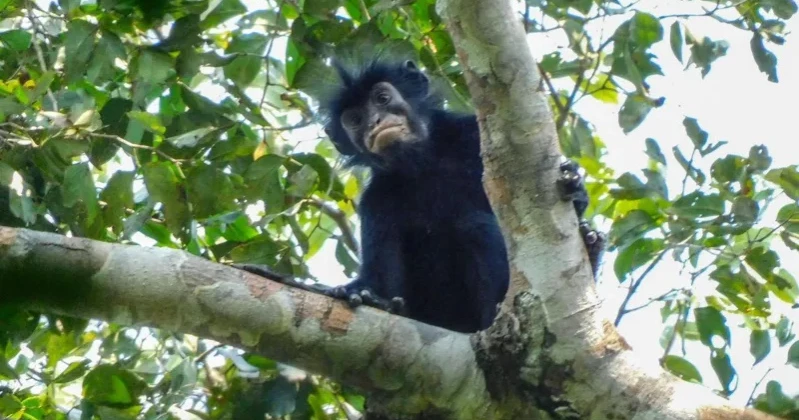
A monkey with striking pinkish-orange lips, a black face and dark fur has been officially identified as a new species living in the forests of the Democratic Republic of Congo (DRC).
The newly identified primate was photographed high in the tree canopy of the dense tropical forests of Lomami National Park in the country's central eastern region.
Conservationists first spotted the unusual monkey in 2008 but managed to capture only a blurry photograph. A second sighting a decade later prompted an international team of researchers to launch a detailed study, which confirmed the animal as a previously unknown species.
It is only the fifth new African monkey species to be formally identified in the past 75 years.
Junior Amboko, a PhD student at Florida Atlantic University, led much of the research, which included field observations, audio recordings, photography and genetic analysis. The findings have been published in the journal PLoS One.
Amboko told BBC News it was an "amazing feeling" to see an animal that so few people knew existed.
A secretive forest primate
Although local communities have long known about the monkey and call it Likweli, scientists only recently confirmed it as a separate species based on its genetic differences.
Amboko said the monkeys are shy and usually remain hidden high in the forest canopy.
As part of the research, scientists interviewed people in 52 villages near the monkeys' habitat, but only residents of eight villages had ever seen them.
The research team, made up of scientists from the DRC, the United States and Germany, named the species Colobus congoensis, recognising the country's rich biodiversity.
The monkey belongs to the colobus group, a type of African monkey that lacks thumbs.
Professor Kate Detwiler of Florida Atlantic University said colobus monkeys are important plant-eating animals that play a key role in forest ecosystems by helping process and spread seeds.
Researchers believe the monkey's bright facial markings may help individuals recognise each other or attract mates.
The species also produces a distinctive deep roaring call.
"You often hear them, but don't see them," Amboko said.
Scientists believe the monkeys are rare and found only in a limited part of the forest that provides the food and habitat they need.
Because the animals are hunted for bushmeat, researchers hope that official recognition of Colobus congoensis as a distinct species will help strengthen conservation efforts.
The team says many questions remain about the newly identified monkey and plans further studies to estimate its population and better understand its behaviour.
Source: BBC