Monkey
New monkey species with orange lips discovered in DR Congo rainforest
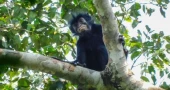
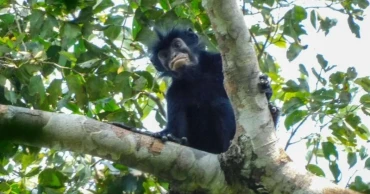
A monkey with striking pinkish-orange lips, a black face and dark fur has been officially identified as a new species living in the forests of the Democratic Republic of Congo (DRC).
The newly identified primate was photographed high in the tree canopy of the dense tropical forests of Lomami National Park in the country's central eastern region.
Conservationists first spotted the unusual monkey in 2008 but managed to capture only a blurry photograph. A second sighting a decade later prompted an international team of researchers to launch a detailed study, which confirmed the animal as a previously unknown species.
It is only the fifth new African monkey species to be formally identified in the past 75 years.
Junior Amboko, a PhD student at Florida Atlantic University, led much of the research, which included field observations, audio recordings, photography and genetic analysis. The findings have been published in the journal PLoS One.
Amboko told BBC News it was an "amazing feeling" to see an animal that so few people knew existed.
A secretive forest primate
Although local communities have long known about the monkey and call it Likweli, scientists only recently confirmed it as a separate species based on its genetic differences.
Amboko said the monkeys are shy and usually remain hidden high in the forest canopy.
As part of the research, scientists interviewed people in 52 villages near the monkeys' habitat, but only residents of eight villages had ever seen them.
The research team, made up of scientists from the DRC, the United States and Germany, named the species Colobus congoensis, recognising the country's rich biodiversity.
The monkey belongs to the colobus group, a type of African monkey that lacks thumbs.
Professor Kate Detwiler of Florida Atlantic University said colobus monkeys are important plant-eating animals that play a key role in forest ecosystems by helping process and spread seeds.
Researchers believe the monkey's bright facial markings may help individuals recognise each other or attract mates.
The species also produces a distinctive deep roaring call.
"You often hear them, but don't see them," Amboko said.
Scientists believe the monkeys are rare and found only in a limited part of the forest that provides the food and habitat they need.
Because the animals are hunted for bushmeat, researchers hope that official recognition of Colobus congoensis as a distinct species will help strengthen conservation efforts.
The team says many questions remain about the newly identified monkey and plans further studies to estimate its population and better understand its behaviour.
Source: BBC
3 months ago

Injured monkey goes to Sitakunda Health Complex, receives treatment
A monkey has become the talk of the locality after it went to Sitakunda Upazila Health Complex in Chattogram twice and received treatment for wounds.
Surprised locals said that the wild animal was first seen in the area around a month back and since then it is frequently seen here and there.
The monkey with wounds was spotted in front of the upazila health complex over the past couple of days.
Dr Nuruddin Rashed, a physician at the upazila health complex, said, “I found the monkey, with wounds, sitting on the balcony of the hospital when I was about to leave work on Saturday afternoon.”
Read: Endangered Lojjaboti monkey rescued in Rangamati, released in Kaptai National Park
Later, he dressed the wounds on the monkey, and it left the health complex, said the doctor.
The monkey again appeared at the hospital on Sunday, he said, adding that brandages were put on the monkey’s wounds. Later, it went away.
“The animal seemed to be in pain and some of the wounds in the back started to rot. This could have happened due to electric shock from sitting on power lines,” he said, adding, “I wanted to know the whereabouts of the monkey when I joined the office today. The monkey was seen sitting on a branch of a tree by the hospital.”
Read more: Endangered Lojjaboti monkey rescued in Bandarban
3 years ago
Monkeys in central Thailand city mark their day with feast
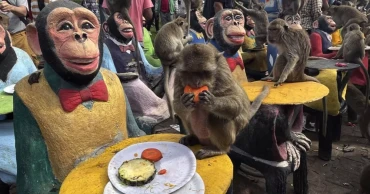
A meal fit for monkeys was served on Sunday at the annual Monkey Feast Festival in central Thailand.
Amid the morning traffic, rows of monkey statues holding trays were lined up outside the compound of the Ancient Three Pagodas, while volunteers prepared food across the road for real monkeys — the symbol of Lopburi province, around 150 kilometers (93 miles) north of Bangkok.
Throngs of macaque monkeys ran around, at times fighting with each other, while the crowds of visitors and locals grew.
As the carefully prepared feast was brought toward the temple, the ravenous creatures began to pounce and were soon devouring the largely vegetarian spread.
While the entertainment value of the festival is high, organizers are quick to point out that it is not just monkey business.
Read: Thailand pre-school shooting: Death toll rises to 36
“This monkey feast festival is a successful event that helps promote Lopburi’s tourism among international tourists every year,” said Yongyuth Kitwatanusont, the festival’s founder.
“Previously, there were around 300 monkeys in Lopburi before increasing to nearly 4,000 nowadays. But Lopburi is known as a monkey city, which means monkeys and people can live in harmony.”
Such harmony could be seen in the lack of shyness exhibited by the monkeys, which climbed on to visitors, vehicles and lampposts. At times the curious animals looked beyond the abundant feast and took an interest in other items.
“There was a monkey on my back as I was trying to take a selfie. He grabbed the sunglasses right off my face and ran off on to the top of a lamppost and was trying to eat them for a while,” said Ayisha Bhatt, an English teacher from California working in Thailand.
The delighted onlookers were largely undeterred by the risk of petty theft, although some were content to exercise caution.
Read: Thailand now offering 10-year visa: Who are eligible?
“We have to take care with them, better leave them to it. Not too near is better,” said Carlos Rodway, a tourist from Cadiz, Spain, having previously been unceremoniously treated as a climbing frame by one audacious monkey.
The festival is an annual tradition in Lopburi, the provincial capital, and held as a way to show gratitude to the monkeys for bringing in tourism. This year’s theme is “monkeys feeding monkeys,” an antidote to previous years where monkey participation had decreased due to high numbers of tourists, which intimidated the animals.
3 years ago