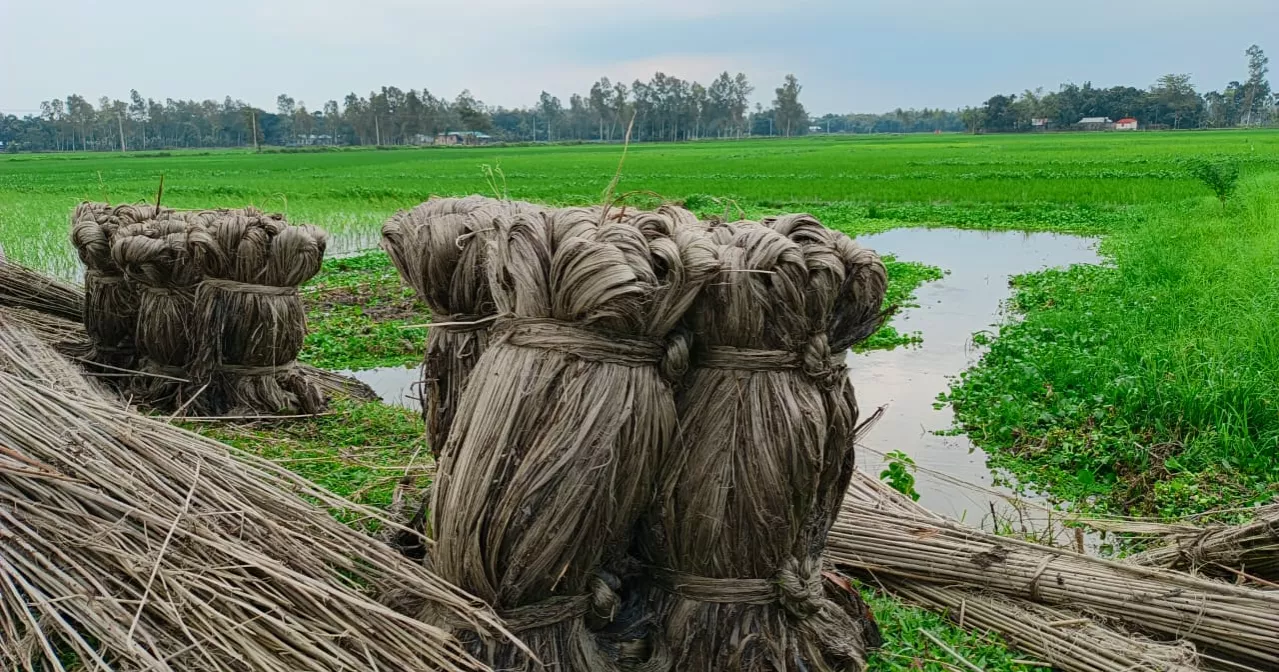
For generations jute has been known as the “golden fibre” of Bangladesh, offering farmers a cash crop that can thrive even on land where other crops struggle.
But for farmers in Lalmonirhat, that golden promise is increasingly turning into a nightmare.
This season, many farmers in the district have failed to get the expected yield of jute and are now worried that falling or uncertain market prices could leave them counting losses yet again.
Unless jute prices rise in line with production costs, farmers fear they will suffer another year of losses, further discouraging them from cultivating the crop next season.
Jute has been widely cultivated this year in the char areas and villages of Aditmari, Kaliganj, Hatibandha, Patgram and Lalmonirhat Sadar upazilas.
Farmers have particularly turned to the chars along the Teesta, Dharla and Saniajan rivers, as well as other flood-prone and previously fallow lands.
Some have also cultivated jute on relatively high land where other crops can be grown.
For many, jute was seen as a practical choice for land where paddy and other crops do not perform well.
But the season has not gone as expected.
Yield hit by weather, disease
During visits to different parts of the district, farmers were found busy extracting fibre from harvested jute after retting—the traditional process of soaking bundled jute plants in water until the woody stems decompose and the fibre can be separated.
The process generally takes around 20 to 25 days. Once the fibre is extracted, farmers wash and dry it in the sun.
Some farmers are still waiting for their jute to complete the retting process.
Farmers said the weather dealt them several blows this season.
At the beginning of the season, dry conditions forced many to irrigate their fields, increasing production costs. Later, excessive rainfall affected the crop in several areas.
Farmers also reported a higher incidence of pests and diseases compared with previous years.
‘The golden fibre has become a noose’
For farmers, the poor yield is only half the problem.
The bigger uncertainty now is the price they will receive for the jute they have produced.
Many farmers said they have struggled for years to recover production costs because of inadequate prices.
Sometimes, they say, selling jute has brought them losses rather than profits.
They fear that another season of poor yields combined with low prices could deepen their financial losses and push them away from jute cultivation altogether.
Farmers fear middlemen’s grip
Farmers also alleged that local middlemen and traders try to control the market during the peak harvesting season through informal syndicates.
According to them, farmers are often forced to sell their jute at prices below production costs because they need immediate cash and have limited access to alternative buyers.
The same jute is later sold at higher prices, allowing middlemen to make greater profits, they claim.
Farmers said the government should intervene to ensure a fair price and create a mechanism to purchase jute directly from growers.
They want jute to be brought under a government procurement system similar to those for paddy and wheat.
Samad Mia, a jute farmer in Aditmari upazila, said farmers needed better support throughout the production cycle. ‘We keep hoping, but keep losing’
“There needs to be more transparency in providing training, quality seeds and agricultural inputs to genuine jute farmers,” he said.
“If those who actually cultivate jute are given priority for training and incentives, production can be increased.”
Nur Habib, a farmer from Chalbala union in Kaliganj upazila, said prolonged waterlogging affected the growth of his jute plants.
“The plants did not grow tall because water remained in the fields for too long. The fibre quality was also not good. We will have to face losses again this year,” he said.
“We cultivate jute every year with hope, but end up facing losses every time,” said Saidul Islam, a char-area farmer.
“This year, excessive rain prevented the plants from growing as expected, so the yield was poor. Now we are worried about what price we will get.”
Bangladesh’s jute sector still has major potential
Despite the problems facing farmers, jute remains an important agricultural and export crop for Bangladesh.
The country is one of the world’s leading producers and exporters of jute and jute products.
According to the Bangladesh Investment Development Authority (BIDA), Bangladesh has favourable conditions for the sector, including extensive waterways for retting and transportation, an established labour force and research capacity. It also identified growing global demand for environmentally friendly products as a major opportunity for the industry.
Jute cultivation is also expanding in some parts of the country when prices and weather conditions are favourable.
Export earnings from jute and jute goods also showed signs of recovery in FY2025-26. Bangladesh Bank’s June 2026 monthly update put earnings from the sector at about $991 million, up 8.93 percent from the previous fiscal year.
The biggest opportunity, however, lies in moving beyond raw fibre and traditional jute goods.
BIDA identifies products such as jute bags, home décor, furniture, footwear, geotextiles and automobile components as areas with export potential. The government also provides export incentives for diversified jute products.