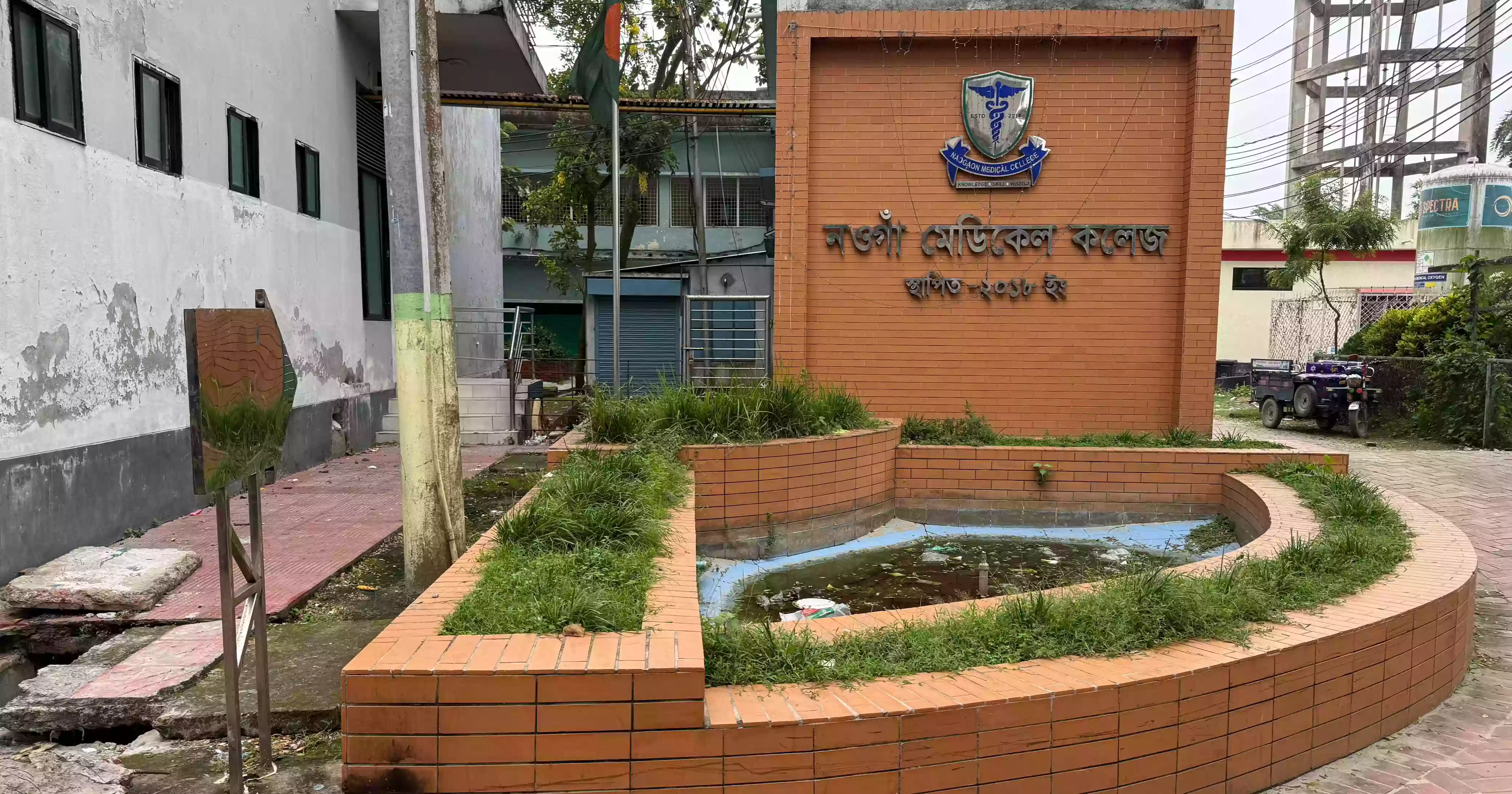
Naogaon Medical College has been operating without a campus of its own for nearly eight years, forcing hundreds of aspiring doctors to pursue their medical education amid severe infrastructural and staffing constraints.
Since its academic activities began in the 2018-19 session, the government medical college has been functioning from a section of the 250-bed Naogaon General Hospital.
While student enrolment has steadily increased over the years, the institution’s facilities and manpower have failed to keep pace, creating challenges ranging from classroom shortages and teacher scarcity to inadequate accommodation and limited clinical exposure.
According to college authorities, the first batch of students has already completed their MBBS degree and internship while the second batch admitted in the 2019-20 session is currently undergoing internship training at the same hospital.
At present, 348 students from the third to eighth batches are studying at the institution, of whom 210 are female.
The college has an approved workforce of 90 positions, including principal, professors, associate professors, assistant professors, lecturers and curators but only 45 posts are currently filled.
The existing faculty consists of one principal, three professors, nine associate professors, six assistant professors, 24 lecturers and two curators.
One of the curators is currently on deputation at Rajshahi Medical College.
With many departments lacking adequate faculty members, teachers are often required to take classes for multiple batches and departments simultaneously.
Faculty members and officials said the situation is affecting not only classroom teaching but also academic supervision and research activities.
Although the college currently runs 11 departments including Anatomy, Physiology, Biochemistry, Forensic Medicine, Pharmacology, Microbiology, Pathology, Medicine, Surgery, Gynaecology and Community Medicine it has only three classrooms for its hundreds of students.
The absence of a dedicated examination hall further compounds the problem.
During examinations, classrooms are converted into exam venues, forcing the suspension of regular classes and disrupting the academic calendar.
The infrastructure limitations extend beyond classrooms.
Departmental heads and consultants lack adequate office space, while administrative, academic and departmental activities are being carried out within the confines of a single building originally not designed to accommodate a medical college.
Students also face significant accommodation challenges.
Many say the lack of residential facilities affects their training and overall educational experience.
“Clinical experience is essential for becoming a competent doctor,” said Anisur Rahman, a student of the college.
“To gain that experience, we need facilities such as a dedicated operation theatre complex, which we do not have because there is no campus of our own. The general hospital also lacks an ICU. As a result, while we are progressing academically, we remain behind in terms of clinical exposure.”
Several students requesting anonymity echoed similar concerns.
“Clinical experience is the most valuable asset for a medical student. But we face serious limitations in this regard,” one student said.
“Many complicated cases requiring advanced treatment are referred to Rajshahi and other medical college hospitals. As a result, we miss opportunities to observe important diseases and treatment procedures firsthand. The environment needed to build confidence as future physicians is still lacking.”
Abdullah Al Hamza, a student of the 2021-22 session, said students at established medical colleges enjoy facilities such as reading rooms, canteens, gymnasiums and playgrounds, all of which are considered important for medical education and student well-being.
“We have none of those facilities,” he said.
Advocate D M Abdul Bari, president of local socio-cultural organisation Ekushey Parishad, said Naogaon Medical College holds immense potential in producing skilled doctors for Naogaon and neighbouring districts.
“However, delays in developing infrastructure, recruiting teachers and constructing a permanent campus are preventing the institution from reaching its full potential,” he said.
“If vacant posts are filled and adequate classrooms and residential facilities are ensured alongside the construction of a permanent campus, the quality of education will improve significantly and the college will be able to function effectively as a full-fledged government medical institution.”
Principal Dr Mukhtar Hossain acknowledged the challenges.
“The biggest problem we face is the lack of our own campus,” he said.
“The building where we currently operate is insufficient for a medical college. We have to suspend classes during examinations, there is not enough office space for teachers and consultants, and we cannot provide residential facilities for all students.”
He also expressed concern over the accommodation situation of female students.
“A section of female students has to stay outside the hostel facilities, often facing security concerns,” he said.
“We have repeatedly written to the Ministry of Health seeking the necessary infrastructure and manpower support.”