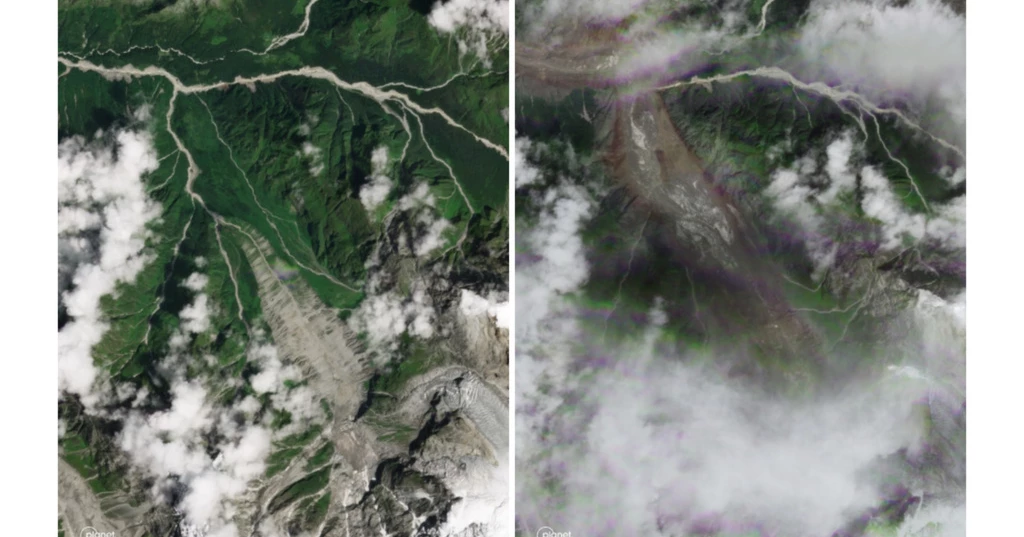
The death toll from catastrophic flash floods along the Nepal-China border has risen to 691, with more than 3,000 people still missing as rescue teams continue searching devastated communities for survivors.
China reported 16 deaths and 546 people missing, while Nepal’s disaster agency said late Saturday that 675 people had died and 2,498 remained missing.
More than 3,700 people have so far been rescued in Nepal.
In Nuwakot, one of the worst-hit districts, helicopters arrived carrying relief supplies, including clothes, instant noodles, crackers and rice, while others evacuated survivors from flood-affected areas.
Many survivors arrived with little more than the clothes they were wearing. Soldiers helped elderly people off helicopters and carried others to medical tents. Several babies were also among those evacuated from the nearby community of Trishuli.
While many residents continued to leave Trishuli, some returned to their devastated homes to look for belongings that could be salvaged.
One resident, Shoba Shretha, returned to find her dog, Sweetie, which she had been forced to leave behind when the floods struck. She was later seen sitting on the ground, petting the dog and giving it water.
At the same time, families in Kathmandu continued searching desperately for missing relatives at the main government hospital.
Many checked help desks and hospital notice boards while carrying photographs of their loved ones. Posters showing photographs and contact numbers of missing people covered hospital walls in the hope of finding information.
In Nuwakot, military personnel posted lists of missing and dead people at a relief centre, drawing crowds of anxious relatives.
Rajesh Kumar Ram, who was searching for his son, said he still hoped he would be found alive.
“I’m hopeful, by chance, that my son is somewhere,” he said through tears.
Priti Kharel was also searching for her brother, Milan Kharel, an engineering geologist working for Doosan Enerbility. She believes he may be among those trapped inside a tunnel at a hydropower construction site.
“We want the government to rescue him as soon as possible,” she said.
Search and rescue operations continued at several locations in Nepal and Tibet, including the Upper Trishuli-1 Hydropower Project in Rasuwa and the badly damaged Gyirong border crossing on the Chinese side.
Nepali Army spokesperson Brig. Gen. Raja Ram Basnet said authorities believe more than 100 people could be trapped inside a tunnel at the hydropower project, where thick mud has made rescue operations extremely difficult.
Rescuers have also remained alert to the possibility of further flooding from a newly formed lake high in the Himalayas. The lake emerged after a glacier collapse triggered the initial floods on Wednesday.
Data from China’s Ministry of Water Resources showed that the lake had decreased in size, with its water level falling by about 10 metres from its peak on Thursday morning, according to state broadcaster CCTV.
Chinese state media also showed rescuers reaching the devastated Gyirong Port and searching the area for survivors. It remains unclear how many people were inside the border checkpoint when the floods struck.
Hundreds of those still missing are foreigners who were in the region for work, trekking or pilgrimage. Chinese state media said 261 foreigners were among the missing, including 104 Nepalis, 49 Indians, 33 Latvians, 18 Americans and 15 Britons.
Nepalese Foreign Minister Shisir Khanal said the government had mobilised all available resources, with international assistance, to locate those still missing and conduct rescue and relief operations.
He said the rugged terrain, steep mountains and narrow gorges were making rescue efforts particularly challenging.
Nepal has sought specialised assistance from neighbouring countries for tunnel rescue operations, survivor-detection technology, rapid forensic and DNA analysis and morgue refrigeration facilities.
An 11-member tunnel rescue reconnaissance team from India has already been deployed, while a similar team from China is expected to arrive soon.
Khanal said Nepal had received more than 57 metric tons of relief supplies from India, while China, Japan, Australia and other countries were also providing assistance. Further international support would be sought based on ongoing assessments of needs.