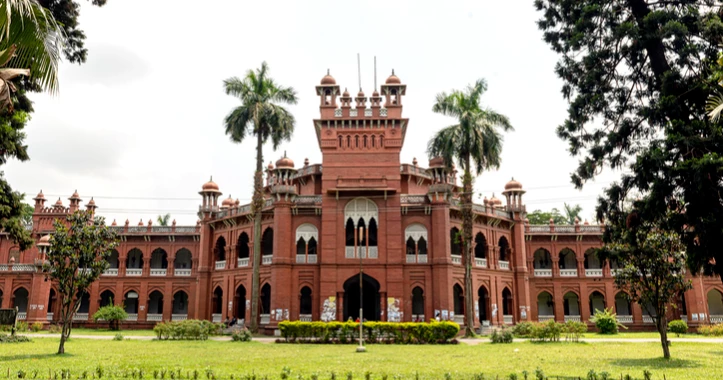
Dhaka University has long been recognized as a vibrant cultural hub in the country, a place where artists find their voice through their activities.
From theater to fine arts, from poetry recitations to musical performances, the university's cultural identity has been inseparable from its academic one. But something appears to be shifting.
In recent times, Dhaka University finds itself in the midst of a quiet yet significant transition. The campus that once echoed with cultural energy now feels noticeably different.
Many claim that large-scale, spirited cultural activities, cultural gathering, and that cultural vibe in campus are no longer as visible as before. Events still take place, but on a smaller scale, with less participation and enthusiasm.
For some students, student leaders, and cultural activists, the changes reflect a broader shift in the university's political and social landscape following July uprising 2024.
They argue that an atmosphere of uncertainty, ideological polarization, and fear of public backlash has discouraged participation in traditional cultural activities. Others, however, believe the campus is simply experiencing a period of adjustment and that cultural practices are evolving rather than disappearing.
Dhaka University's cultural identity was shaped not only by organized events but also by everyday interactions that animated campus spaces.
The Teacher-Student Centre (TSC), Charukola, and other spots hosted informal rehearsals, musical performances, recitation sessions, and cultural discussions. These activities fostered a sense of community and made culture a visible and integral part of campus life.
A cultural activist and former student of DU, Robiul Hossain, said especially before Covid-19, there was a strong culture centering TSC. Every day from 10am to midnight, apart from the club, small groups (from department or outside) would practice singing, reciting or dancing. Many people would flock to see their beautiful cultural chat.
Students were much more aware and interested in these topics back then, and the clubs received a very good response from sponsors and audiences alike, he added.
Cultural organizations held programmes regularly while departmental events also showcased elements of indigenous and Bengali culture. Pohela Boishakh and year-round programmes at Charukola attracted large and diverse crowds.
However, Robiul said that the university's cultural space has narrowed significantly since August 5. 'Before the July Uprising, the main concern was whether any program would go against the Awami League and Bangabandhu.
But after August 5, I thought that cultural practices would be carried out properly, but it did not happen. Everyone went through a fear of mob culture. Nothing major may have happened directly at DU, but we had to face many things indirectly.'
There is also debate surrounding cultural practices centering Liberation War. Many believe, since the July uprising, attempts have been made to position the July and Liberation War against each other, undermining the spirit of the Liberation War.
Last year, an exhibition organized by Islami Chhatra Shibir at TSC displayed photographs of several individuals convicted by the International Crimes Tribunal for crimes against humanity committed during the 1971 Liberation War.
The exhibition sparked widespread criticism on social media and drew protests from various political, social, and cultural student organizations, teachers and students. Following the controversy, the university administration removed the photographs from the exhibition.
Robiul Hossain said, "During our time, many programmes were organized around the Liberation War. However, they mainly focused on the Awami League or Chhatra League, as if the Liberation War was solely their contribution. We failed to present the full and accurate history."
"There was an opportunity after August 5 to present that history properly, but unfortunately we could not do so. Now there are attempts to place the Liberation War and the July movement in opposition to each other," he added. "As a result, many TSC-based organizations are reluctant to work on Liberation War-related themes for fear of being labelled."
Sheikh Tasnim Afroz Emi, a former vice-president of Shamsun Nahar Hall Union, alleged that after August 5, some coordinators occupied the room of Slogan '71, a registered TSC-based organisation, and renamed it "Inquilab 24".
However, the director of TSC confirmed that Room 207 is currently being used by the Dhaka University Literature Society and the Dhaka University Career Club, not by Inquilab 24.
DUCSU’s role questioned
After years without elected student representation, many students saw the return of an elected DUCSU panel as an opportunity to help restore a healthy campus environment and support the university's cultural traditions. But some students and activists now allege that DUCSU has failed to play that role and instead represents a particular group.
Although they are hesitant to state it on the record, the clear indication here is towards the Jamaat e Islami, whose student wing, the Islami Chhhatra Shibir, who backed the panel that swept the election. Even against the background of the July Uprising, the result stunned the nation.
Abdul Kader, who rose to prominence as a leader of the student-led uprising of 2024, was a VP candidate in the last DUCSU election,for a panel seen as most closely aligned to the student protesters of 2024, via the National Citizen Party.
He claimed that the student body has increasingly become representative of a specific Islamist-oriented group.
He alleged that DUCSU's literature and cultural secretary has primarily organized programmes of an "Islamic orientation" while showing little initiative in arranging broader cultural events.
"DUCSU and the current student representatives have failed to create an environment where artists feel safe and encouraged," Kader also said. "They could have helped rebuild the cultural sphere, but their activism has become one-dimensional. They need to understand that they represent the entire student body, not just one group."
Describing the current situation as confusing, Kader added that while the campus may have been freed from the influence of Awami League and Chhatra League, it has not been returned to ordinary students. Instead, he alleged, “another conservative group” - again, the only logical inference being Jamaat-Shibir iophas come to dominate parts of campus life.
Rise of Qawwali and Milad Mahfil
Among the most noticeable developments since August 2024 has been the growing visibility of Islamic cultural events, particularly Qawwali performances and Milad Mahfils.
Dhaka University Cultural Society’s President Atikur Rahman Toha said, "I think this may have been an attempt to establish an alternative cultural stream in opposition to the longstanding traditions of Bengali culture."
However, such events are no longer as visible as they once were. "Ultimately, it appears that the effort to position Qawwali culture as a competing cultural force was not successful. That is why the trend has gradually lost momentum," Toha said.
Robiul Hossain, however, rejects the notion that such practices are entirely new.
"Milad gatherings always existed, especially in residential halls. The difference is that they were usually confined to mosques and smaller settings," he said.
He argues that Muslim students should have legitimate cultural spaces and that, in previous years, Islamic cultural expressions were often unfairly labeled as anti-Liberation War or politically problematic.
At the same time, Robiul believes some groups have used Islamic cultural activities as a form of political expression.
"Qawwali is a rich and valuable cultural tradition. But when it becomes associated with political messaging, people begin to perceive it politically rather than culturally. Some of the post-August initiatives were motivated as much by politics as by culture."
Inevitable decline or temporary disruption?
Many argue that the main reasons behind the decline of cultural activities at the University were a sense of ‘unknown fear,’ ‘uncertainty,’ and the fear of ‘mob culture.’ Others believe that although cultural events temporarily decreased after August 5 due to the formation of new committees and organizational restructuring within cultural organizations, activities are now gradually returning to normal.
Robiul Hossain said, “After the fall of the government on August 5, those of us who remained neutral hoped that we would finally be able to engage in cultural activities freely and without obstacles. However, that did not happen, mainly because of the influence of ‘mob culture.’
“Because of this mob culture, everyone went through a period of fear. Although no major incidents occurred directly at Dhaka University, we had to face many challenges indirectly.’
He further said, ‘Before August 5, there were many talented artists and club members who had family ties or other connections with Awami League or Chhatra League.
Many of them were not involved in any controversial activities, but after August 5, they withdrew from public participation. As this significant group stepped away, cultural activities centering TSC and the university became even more limited. Finding active members for TSC activities has now become a challenge.’
On the other hand, Atikur Rahman Toha said that cultural events at the university did decline to some extent after August 5 - and that is both true and undeniable. However, events are now being held regularly again, and their activities are moving forward at a normal pace.
“There were several reasons behind the decline in events during that period. There was an atmosphere of fear and uncertainty. At the same time, the formation of new committees within the clubs and the need to manage various internal matters required considerable time. Taken together, these factors delayed the return to stability.”