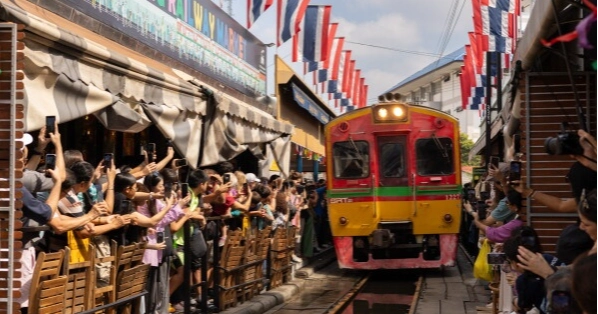
Soaring fuel prices and global disruptions linked to the Iran war are putting pressure on tourism-dependent economies across Southeast Asia, just as the region heads into its peak travel season.
Countries such as Thailand, Vietnam and Cambodia are facing weaker travel demand, higher airfares and flight disruptions driven by rising jet fuel costs and uncertainty over the conflict’s impact on global energy supplies.
Tourism in Asia is still recovering from the COVID-19 pandemic, but officials say the new shock is hitting the sector before it fully stabilises. Higher transport and living costs are also prompting many families to cut back on travel.
“With fuel prices going up and tourists declining, how can we earn?” said Siv Pech, a 58-year-old tuk-tuk driver near Cambodia’s famous Angkor Wat temple complex in Siem Reap.
Tourism plays a key role in many Southeast Asian economies, accounting for nearly 13% of GDP in Thailand, around 9% in Vietnam, and supporting millions of jobs in Cambodia. It is also a major source of foreign currency for import-reliant countries such as the Philippines and Nepal.
The conflict has pushed up global oil prices, raising transport costs across the region, particularly for countries dependent on fuel imports that previously relied on stable shipping routes through the Strait of Hormuz.
Industry experts warn that the combined impact of the pandemic and the war is creating a difficult environment for recovery.
“This, coming within five years of the pandemic, is devastating for tourism,” said Jitsai Santaputra of energy consultancy The Lantau Group.
Airlines cut flights as fuel costs surge
Higher jet fuel prices and supply pressures have forced several airlines, including Vietnam Airlines, AirAsia and Cathay Pacific, to reduce flights or adjust schedules.
Airspace restrictions in parts of the Persian Gulf and longer flight routes have also increased operating costs for carriers flying between Europe and Asia.
As a result, ticket prices have risen sharply. Cathay Pacific, for example, has significantly increased fuel surcharges for both medium- and long-haul flights.
Company officials say jet fuel costs remain elevated, adding further pressure on pricing. Travelers are also booking later than usual, reflecting uncertainty over travel conditions.
Travel plans disrupted
For many travellers, the rising costs are forcing difficult decisions.
Freelance travel writer Sandra Awodele had planned a long-awaited trip to Thailand this summer but abandoned her plans after checking flight prices.
“I looked at the fares and that was the end of it,” she said.
Local workers feel the strain
The impact is also being felt on the ground across Southeast Asia, where tourism supports millions of small businesses and informal workers.
In Cambodia’s Siem Reap, tuk-tuk driver Siv Pech said his income has fallen sharply. He now earns as little as $5 a day, down from about $20 previously, with fuel costs taking up most of his earnings.
“Some days I don’t earn anything at all,” he said.
Restaurants and small businesses are also under pressure as rising gas and food prices squeeze profits.
Weak outlook for regional tourism
Tourism accounts for a significant share of economic activity across Southeast Asia, with the industry contributing nearly 11% of GDP in ASEAN countries before the pandemic.
Economists warn the Iran conflict could slow growth across Asia-Pacific by reducing travel demand and increasing costs for businesses and consumers.
“Higher prices and weaker demand will weigh on tourism and overall growth,” said Albert Park, chief economist at the Asian Development Bank.
In Vietnam, hotel operators say travellers are increasingly choosing cheaper accommodation options or cutting back on trips altogether.
“This will affect the entire tourism chain,” said hotel operator Le Tuyet Lan.
Thailand sees drop in arrivals
Thailand, one of the region’s top tourist destinations, has already recorded a decline in visitor numbers. Official data show an overall 7% drop in April, with sharp declines from Europe and the Middle East.
In Cambodia, tourism officials also report a steep fall in arrivals to Siem Reap, home to the Angkor Wat temple complex.
Business owners say rising energy and food costs are adding further pressure, making it harder to stay profitable.
“We are worried about inflation and rising costs,” said restaurant owner Sokha Sambo, who employs 14 staff in Siem Reap.