U.S. President Donald Trump said Thursday he had called off new military strikes on Iran, claiming a breakthrough in negotiations to end the war just hours after the American leader threatened to escalate the conflict by seizing control of Iran’s oil industry.
Trump has said multiple times in recent weeks that the warring parties have been on the cusp of a deal without anything coming to fruition. A spokesperson for Iran’s Foreign Ministry said in a live phone call on state television that mediators were active and nothing had been finalized to end the conflict that began Feb. 28 when the U.S. and Israel jointly attacked Iran.
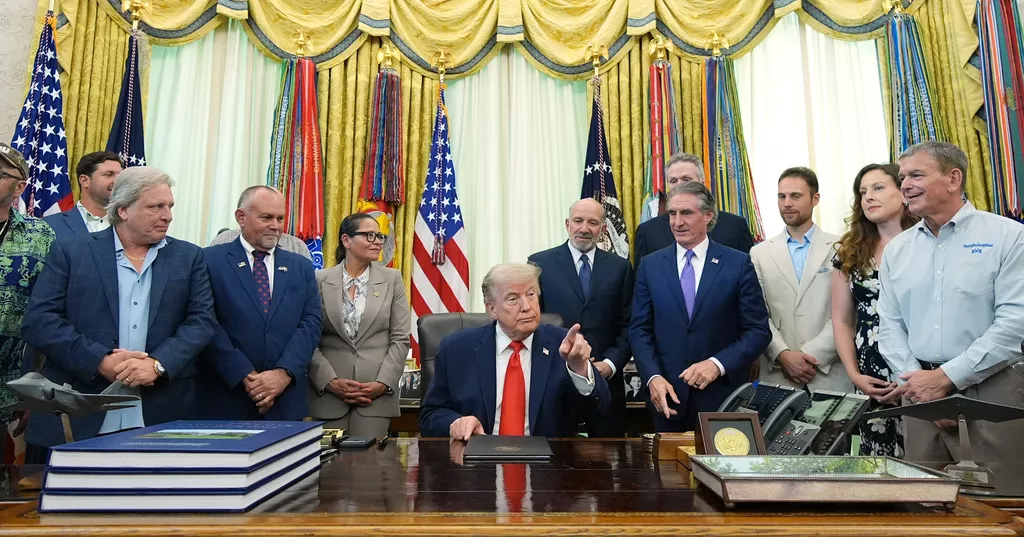
Trump opened an Oval Office event Thursday afternoon saying: “We just made a great settlement of the war with Iran.” He offered scant details, other than to say he expects an agreement to extend a fragile ceasefire that started in April to be finalized “over the next few days.”
Extending the terms of the ceasefire gives U.S. leaders more time to negotiate over Iran’s nuclear program, the main reason Trump and Israeli Prime Minister Benjamin Netanyahu used to justify launching the war. Netanyahu’s office said Thursday that Israel is not a party to the emerging agreement between the U.S. and Iran.
The announcement came after two days of back-and-forth attacks between the U.S. and Iran had pushed the Middle East closer to the resumption of a full-scale war.
Trump had threatened further escalation earlier Thursday, posting on social media that the U.S. would hit Iran “VERY HARD TONIGHT” and take “total control” of its oil and gas industries. A few hours later, Trump posted on social media that significant points in the negotiations “have been brought to the highest level of Iranian leadership and approved.”
Esmail Baghaei, the spokesperson for Iran’s Foreign Ministry, said in his phone call on state television that text of a deal is “mostly finalized.”
“The problem is that the contradictions in America’s position has caused turbulence to this process,” he said Thursday night.
A major sticking point in negotiations has been Iran’s nuclear program, which the U.S. and Israel fear could lead to an atomic weapon, but which Tehran says is for peaceful purposes. Another key issue is Iran’s stranglehold on the Strait of Hormuz, a critical shipping lane for transporting oil and natural gas.
Trump again moves quickly from threats to negotiating
Trump’s rapid shift Thursday from dire threats to promoting peace negotiations again underscored his whipsaw approach to the war. He suggested on Monday that a deal to end the conflict could be reached in a matter of days.
Then back-and-forth strikes rattled the Middle East this week. The first involved attacks between Iran and Israel, followed by the two rounds of fire between the U.S. and Iran, which targeted countries where U.S. troops are based. The U.S. strikes began after Trump blamed Iran for downing an American attack helicopter near the Strait of Hormuz. Both pilots were rescued safely.
Iran’s Foreign Ministry said the U.S. attacks had “effectively rendered the ceasefire ... meaningless,” without saying it was abandoning it.
After Trump threatened more attacks were to come on Thursday, Iran’s parliamentary speaker, Mohammad Bagher Qalibaf, responded on social media that “wrong strategies and impulsive decisions” would wreak havoc on energy markets and “create an endless quagmire that you will be stuck in for years.”
It wasn’t the first time Trump threatened escalation before giving negotiations another chance. In April, he warned Iran that “a whole civilization will die tonight, never to be brought back again” if it didn’t agree to his terms, before extending a ceasefire.