BBS

Inflation eases further to 8.32% in July
Bangladesh’s headline inflation fell to 8.32 percent in July 2026 from 9.16 percent in June, mainly driven by a significant decline in food inflation, according to data released by the Bangladesh Bureau of Statistics (BBS).
The latest BBS data show that food inflation dropped to 7.16 percent in July, from 8.60 percent in June, while non-food inflation eased to 9.28 percent from 9.61 percent during the period.
The July inflation rate was also lower than the 9.42 percent recorded in May 2026, indicating a continued moderation in overall price pressure over the past two months.
On a month-on-month basis, however, the general price index increased by 1.44 percent in July, compared to a 0.34 percent rise in June. Food prices rose by 2.57 percent during the month, while non-food prices increased by 0.53 percent.
The inflation situation was slightly higher in rural areas than in urban areas in July.
Rural inflation stood at 8.36 percent, with food inflation at 7.14 percent and non-food inflation at 9.53 percent.
In urban areas, headline inflation was 8.24 percent, while food and non-food inflation stood at 7.21 percent and 8.90 percent respectively.
The 12-month moving average inflation also declined to 8.66 percent in the period from August 2025 to July 2026, compared to 9.77 percent in the corresponding previous 12-month period.
Meanwhile, the Wage Rate Index increased by 8.22 percent year-on-year in July, slightly up from 8.18 percent in June. Wage growth in agriculture stood at 8.24 percent, while it was 8.15 percent in industry and 8.39 percent in the services sector.
The BBS publishes the monthly Consumer Price Index and inflation data based on a 2021-22 reference year. The CPI covers national, rural and urban consumer groups.
2 months ago

Food prices push January inflation up to 8.58%: BBS
Bangladesh’s point-to-point general inflation edged up slightly to 8.58 per cent in January 2026 from 8.49 per cent in December 2025, mainly due to higher food prices, according to the latest data from the Bangladesh Bureau of Statistics (BBS).
The BBS data showed food inflation rose to 8.29 per cent in January from 7.71 per cent in the previous month, while non-food inflation fell to 8.81 per cent from 9.13 per cent.
Both rural and urban areas saw modest increases in overall inflation.
In rural areas, the general point-to-point inflation stood at 8.63 per cent in January, up from 8.48 per cent in December 2025, though it was higher at 10.18 per cent in January 2025.
Rural food inflation climbed to 8.18 per cent from 7.67 per cent while non-food inflation decreased to 9.04 per cent from 9.26 per cent.
In January 2025, rural food and non-food inflation were 10.61 per cent and 9.77 per cent respectively.
In urban areas, general inflation rose slightly to 8.57 per cent in January from 8.55 per cent in December.
Urban food inflation increased to 8.61 per cent from 7.87 per cent, whereas non-food inflation fell to 8.54 per cent from 8.99 per cent.
In January 2025, urban food and non-food inflation were 10.95 per cent and 9.25 per cent respectively.
8 months ago

Bangladesh’s GDP growth rises to 4.5% in Q1 of FY2025–26
Bangladesh’s economy posted a stronger performance in the first quarter (Q1) of the 2025-26 fiscal year, with gross domestic product (GDP) growth accelerating to 4.50 percent on a point-to-point basis in constant prices, according to provisional estimates.
The latest quarterly figures show a notable improvement compared to the same period of the previous fiscal year, when GDP growth stood at 2.58 percent, reflecting a broad-based recovery driven mainly by the industrial sector alongside improvements in agriculture and services.
In current prices, the size of GDP in Q1 of FY26 has been estimated at Tk 13,853,433 million (Tk 13,853 billion), up from Tk 12,401,032 million (Tk 12,401 billion) recorded in the first quarter of FY25, indicating a substantial expansion in nominal economic activity year-on-year.
According to quarterly-based estimates, the growth rate of gross domestic product at constant prices for the entire FY25 has been placed at 3.72 percent.
Read more: Bangladesh sees $1.12bn in remittances in first 10 days of January
The Bangladesh Bureau of Statistics (BBS) noted that this quarterly-based estimate differs from the provisional annual GDP estimate for FY25 prepared on a yearly basis.
The discrepancy will be addressed through internationally accepted benchmarking methods once the final annual GDP figures for FY25 are compiled, ensuring consistency between quarterly and annual national accounts.
The agriculture sector returned to positive territory in Q1 of FY26, registering a growth of 2.30 percent at constant prices on a point-to-point basis.
This marks a significant turnaround from the contraction of 0.60 percent recorded in the same quarter of FY25.
The improvement in agricultural output suggests a degree of stabilisation following earlier disruptions, supported by better crop performance and a gradual recovery in allied activities such as livestock and fisheries.
The rebound in agriculture is expected to provide some relief to rural incomes and food supply dynamics.
The industrial sector emerged as the strongest performer, posting a robust growth of 6.97 percent in Q1 of FY26, nearly double the 3.59 percent growth recorded in the corresponding quarter of the previous fiscal year.
Analysts view the sharp acceleration in industrial growth as a key driver of the overall economic upturn, reflecting improved manufacturing activity, gradual easing of energy-related constraints and a modest pickup in domestic demand.
Export-oriented industries, particularly manufacturing, are believed to have contributed significantly to the sector’s stronger performance.
Bangladesh’s GDP growth slows to 3.97% in FY2024–25
The services sector also recorded improved growth, expanding by 3.67 percent in Q1 of FY26 compared to 2.96 percent in the same quarter of FY25.
The expansion in services indicates a gradual revival in trade, transport, communications and other service-related activities, which had remained under pressure amid economic uncertainty and subdued consumption in the previous year.
The stronger GDP growth in the first quarter of FY26 points to early signs of economic recovery, supported by improved sectoral performance across agriculture, industry and services.
However, economists caution that sustaining this momentum will depend on continued policy support, stability in the macroeconomic environment and progress in addressing structural challenges.
The provisional nature of the quarterly estimates also underscores the need for careful interpretation, with revisions expected as more comprehensive data become available.
Nonetheless, the Q1 figures provide an encouraging signal at the start of the fiscal year, suggesting that growth is gradually gaining pace after a period of slowdown.
Read more: Forex reserves hit 3-year high as December remittances cross $3bn
9 months ago

Inflation edges up in December
Bangladesh’s general point-to-point inflation rate rose slightly to 8.49 percent in December 2025 from 8.29 percent in November, according to the latest figures from the Bangladesh Bureau of Statistics (BBS).
The modest increase was driven by rises in both food and non-food prices.
Food inflation inched up to 7.71 percent in December from 7.36 percent in November while non-food inflation rose to 9.13 percent from 9.08 percent over the same period.
Inflation slightly down in January as food prices decrease on back of increased supplies
Inflation in both rural and urban areas also recorded slight increases last month reflecting a gradual upward trend across the country.
9 months ago

The year in finance: Stability achieved, but hard work lies ahead
Bangladesh’s financial sector stands at a defining juncture at the end of the 2025, marked by cautious stabilisation efforts but weighed down by deep-rooted structural weaknesses.
While policymakers point to modest macroeconomic improvements and renewed discipline, restoring confidence, reviving private investment and repairing the financial system remain formidable challenges.
From a macroeconomic standpoint, 2025 was largely a year of consolidation rather than acceleration. Inflation stayed elevated for much of the year, compelling authorities to maintain a tight monetary stance.
Although inflationary pressures eased slightly towards year-end, the adjustment came at the cost of slower economic activity.
According to the Bangladesh Bureau of Statistics (BBS), the general point-to-point inflation rate stood at 8.29 percent in November 2025, marginally up from 8.17 percent in October.
Economic growth also fell short of earlier targets, reflecting subdued domestic demand and weak private sector investment.
Both the government and the central bank repeatedly argued that short-term pain was necessary to restore macroeconomic balance and credibility.
The financial sector—particularly the banking system—remained the most critical pressure point throughout the year.
Non-performing loans stayed stubbornly high, underscoring long-standing governance failures, weak credit appraisal and ineffective recovery mechanisms.
Despite repeated reform pledges, defaulted loans continued to erode bank balance sheets, limiting their ability to extend fresh credit.
Financial sector reforms showing visible progress despite challenges: Governor
Defaulted loans in the country's banking sector reached 34.6 percent of all disbursed credit till June this year, the highest level since 2000, exposing the fragile state of the banking system and renewing concerns about financial governance. Defaults surge to 34.6 percent of credit as Bad loans jump Tk 3,88,573 crore while Irregularities, weak oversight fuel crisis and the State banks hold 44.6 percent defaults.
For much of 2025, banks prioritised liquidity management and survival over risk-taking, further tightening credit conditions for businesses.
In a major intervention, Bangladesh Bank merged five struggling Islamic banks—First Security Islami Bank, Union Bank, Global Islami Bank, Social Islami Bank and EXIM Bank—into a new state-backed entity, tentatively named Sammilito Islami Bank (United Islamic Bank).
The central bank dissolved their boards, appointed administrators and injected government capital to protect depositors and restore confidence, aiming to create a unified and stronger Islamic bank by late 2025 or early 2026.
Private sector credit growth remained one of the weakest indicators in 2025, falling to a four-year low of around 6.23 percent by October, well below the central bank’s target. High interest rates, political uncertainty, power shortages and weak investor confidence discouraged borrowing, stalling new investment and business expansion despite export growth.
High lending rates—often 16–17 percent—combined with stricter collateral requirements, led many entrepreneurs to delay expansion or rely on internal funds. The slowdown in capital machinery imports for much of the year reflected this hesitation.
However, signs of cautious recovery emerged late in the year. Letters of Credit (LCs) for capital machinery rose by about 23 percent in the first quarter of FY2025-26, following three years of decline. During the July–September 2025 quarter, LCs climbed to $471.7 million, up from $383.9 million a year earlier, driven mainly by export-oriented sectors such as textiles, supported by improving foreign exchange stability.
Still, overall private investment remained subdued. Private investment as a share of GDP fell to 22.48 percent in FY2024-25, the lowest in five years, signalling waning confidence at a critical moment as Bangladesh prepares for graduation from Least Developed Country (LDC) status.
Investor sentiment in 2025 was shaped not only by financial conditions but also by broader governance concerns. Businesses frequently cited policy uncertainty, administrative delays and weak contract enforcement as major deterrents. While several reform initiatives were announced, uneven implementation led many local investors to adopt a wait-and-see approach, while foreign investors remained cautious despite Bangladesh’s large market and strategic location.
The capital market offered limited relief. Although there were brief rallies, overall performance failed to attract significant new investment. Volatility, governance issues and limited market depth continued to undermine the stock market’s role as a source of long-term financing.
IMF team meets BNP, discusses reforms in financial, social sectors
On the policy front, Bangladesh Bank emphasised stronger supervision, improved loan classification and better corporate governance. Discussions on bank consolidation and stricter fit-and-proper criteria for directors gained prominence, though scepticism persisted over whether entrenched interests would allow deep reforms to take root.
Meanwhile, the government continued to rely heavily on public investment to support economic activity. Large infrastructure projects played a stabilising role amid private sector hesitation, though economists warned that excessive dependence on public spending could crowd out private investment and raise concerns over efficiency, cost overruns and debt sustainability.
The external sector provided some relief. Remittance inflows remained strong, helping stabilise foreign exchange reserves, while export earnings showed resilience despite global uncertainties.
Bangladesh saw strong remittance inflows in 2025, crossing $30 billion for the fiscal year (FY25) and showing significant growth in the first half of FY26 (July-Dec 2025), reaching over $15 billion with monthly figures like November's $2.89 billion and a record $3.29 billion in March, driven by a stable exchange rate and crackdowns on informal transfers, boosting the economy.
In the July-November period, remittance Inflows reached approximately $13.03 billion, a significant jump from $11.13 billion the previous year. In November 2025, A robust $2.89 billion, up over 31% from November 2024 while in March 2025, a record monthly inflow of $3.29 billion.
Export receipts exceeded $20 billion in the first half of FY2025-26, driven mainly by the apparel sector. For FY2024-25, total exports reached $48.28 billion, with RMG earnings at $39.34 billion.
As 2025 ends, there is cautious recognition that stabilisation has been achieved, but there is broad agreement that the hardest work lies ahead. Restoring trust in financial institutions, curbing loan defaults and ensuring predictable policy implementation are essential to unlocking private investment.
Without decisive reforms, growth is likely to remain below potential, limiting Bangladesh’s ability to absorb its growing labour force—especially as concessional financing and trade preferences diminish after LDC graduation.
BRTA provides financial assistance to families of road crash victims in Joypurhat
In that sense, 2025 may be remembered as a transitional year—highlighting both the resilience of Bangladesh’s economy and the depth of its structural weaknesses.
Whether this adjustment phase evolves into a foundation for sustainable and inclusive growth will depend largely on how effectively financial sector reforms are implemented and private sector confidence is restored in the years ahead.
9 months ago
BRTA tops corruption list among public service offices: BBS survey
The Bangladesh Road Transport Authority (BRTA) has been identified as the most corruption-prone public service office in the country, according to the Citizen Perception Survey (CPS) 2025, released by the Bangladesh Bureau of Statistics (BBS).
The survey found that 63.29 percent of citizens who sought services from BRTA experienced corruption. BRTA was followed by law enforcement agencies (57.96 percent) and passport offices (57.45 percent) on the corruption list.
The report was unveiled on Wednesday at the BBS auditorium in Agargaon, Dhaka.
According to the survey, 31.67 percent of respondents admitted to having paid bribes directly while receiving government services in the past 12 months.
Read more: BRTA chairman wants to see accident-free roads
The rate of bribery was significantly higher among men (38.62 percent) compared to women (22.71 percent). An overwhelming 98.48 percent of respondents reported paying bribes in cash.
BBS conducted the nationwide CPS between February 6 and 23, 2025, covering 64 districts. Data were collected through interviews with 84,807 respondents aged 18 and above (39,894 men and 44,913 women) from 45,888 households across 1,920 Primary Sampling Units (PSUs).
The findings show that 63.29 percent of respondents who interacted with BRTA officials admitted to paying bribes to receive services, making it the most corruption-prone government office among those surveyed, while the least bribery was recorded in government and autonomous banks and insurance offices (2.98 percent), public educational institutions (2.94 percent), and the Anti-Corruption Commission (ACC) itself, which stood at 1.99 percent.
Law enforcement agencies ranked second, where 61.94 percent of service recipients said they had to pay bribes. This was followed by the passport office at 57.45 percent and the land registry (cadastre) office at 54.92 percent, highlighting persistent corruption in citizen-facing and documentation-related services.
Read more: Road crashes claim 380 lives in July: BRTA
More than half of the respondents also reported bribery in interactions with judges, magistrates, prosecutors and other legal officials (53.77 percent), and the land record, acquisition and settlement offices (51.40 percent).
At the mid-range, bribery was reported by 44.68 percent of respondents dealing with accounts offices, while customs, excise, and VAT offices recorded 35.37 percent. Local government offices at the union parishad, pourashava, and upazila levels stood at 32.91 percent, followed by district and upazila election offices at 26.04 percent.
Lower levels of bribery were reported in social security and welfare offices (19.20 percent) and public utility services such as electricity, water and gas (18.41 percent). Interactions with elected local government representatives (14.94 percent) and income tax or revenue offices (14.08 percent) showed relatively lower but still notable corruption.
Bribery incidence was lowest in the district and upazila administration (11.33 percent), agricultural offices (9.07 percent), and among public healthcare providers, including doctors and nurses (8.05 percent). Only 7.91 percent reported bribery involving elected Members of Parliament.
The data underscore deep-rooted governance challenges, particularly in transport, law enforcement and land-related services, where citizens’ dependence on officials continues to fuel informal payments despite ongoing reform efforts.
The survey assessed progress on six indicators of Sustainable Development Goal (SDG) 16, based on citizens’ perceptions and experiences related to security, good governance, quality of public services, corruption, access to justice, and discrimination.
Read more: CNG drivers block road outside BRTA prompting Mohakhali-Uttara tailback
Nationally, the average household size was four members, with 81.97 percent male-headed households and 18.03 percent female-headed households.
On security, 84.81 percent of citizens reported feeling safe walking alone in their neighbourhoods after sunset while the sense of safety was lower among women (80.67 percent) compared to men (89.53 percent). The feeling of safety inside one’s home after dark was higher at 92.54 percent.
In terms of governance, only 27.24 percent of citizens believed they could influence government decisions, while this figure dropped to 21.99 percent regarding political decision-making.
Nationally, about 24.62 percent of respondents felt that the country’s political system is inclusive and responsive, with little difference between rural (24.47 percent) and urban (24.91 percent) areas.
Regarding public service delivery over the past year, 47.12 percent of respondents accessed government health services, while 40.93 percent reported that at least one of their children attended a government primary or secondary school.
Besides, 73.77 percent sought other government services such as identity cards or civil registration.
Satisfaction levels varied across services: 72.69 percent for healthcare, 81.56 percent for primary education, 78.18 percent for secondary education, and 66.91 percent for other government services.
The survey also found that 16.16 percent of citizens experienced disputes or conflicts in the past two years.
Among them, 83.60 percent had access to some form of dispute resolution, either formal (such as courts) or informal (such as community leaders). Of these, 41.34 percent used formal institutions, while 68.96 percent relied on informal mechanisms.
On discrimination, 19.31 percent of respondents reported experiencing some form of discrimination.
Read more: BRTA provides financial assistance to families of road crash victims in Joypurhat
The main bases were socio-economic status (6.82 percent) and gender (4.47 percent). Incidents occurred most frequently within families (49.72 percent), in public transport or open spaces (34.82 percent), and at workplaces (24.85 percent). Only 5.37 percent of victims reported such incidents to the authorities.
9 months ago

Taskforce recommends reforms, renaming BBS into StatBD
An Independent Taskforce on Strengthening Bangladesh Bureau of Statistics (BBS) on Monday recommended reforms to transform the agency into a modern and trusted national statistical organization and rebranding it as Statistics Bangladesh (StatBD).
The Taskforce, chaired by Executive Chairman of the Power and Participation Research Centre (PPRC) Dr. Hossain Zillur Rahman formally submitted its report to the Planning Adviser Dr Wahiduddin Mahmud at his office.
The Taskforce has proposed elevating the head of StatBD to the position of Chief Statistician, a Special Scale post, to underscore independence and professionalism.
It also recommended creating the Trust and Transparency Council of Statistics (TTCS) — a seven-member body chaired by the Planning Adviser.
This high-level council would provide institutional oversight, review annual performance and expenditure audits, and oversee the selection of the Chief Statistician.
The Taskforce also suggested amendments to the Statistics Act 2013 to guarantee StatBD’s autonomy in technical matters such as data validation and release and thereby insulating official statistics from administrative or political interference.
MJF applauds BBS recognition of women's unpaid work at GDP’s 18.9%
To address chronic staffing shortages and structural weaknesses, the report recommended expanding the organisational structure from eight to sixteen wings, creating 437 new Upazila-level posts to strengthen local presence and unifying cadre and non-cadre services.
On the financial front, the report prioritises budgetary independence, calling for dedicated revenue funding for core surveys and an immediate Tk. 50 crore allocation to stabilise annual survey operations.
To rebuild public confidence, the Taskforce has advocated for an open data and release policy that ensures pre-announced data release calendars, simultaneous access for all users and publication of full metadata and methodological notes.
It also proposed holding an Annual Stakeholder Conference to strengthen dialogue among statisticians, policymakers, civil society and the private sector.
Advisory committees for major surveys and internship opportunities for young professionals would help make statistical outputs more relevant and credible, it said.
The report emphasises capacity building through the transformation of the current training centre into a StatBD Training Academy.
The academy would offer structured courses for new recruits, mid-career professionals, and senior management.
Bangladesh's food security at risk as farmland shrinks by 3.75 percent in 8 Years: BBS Survey
It also recommends establishing a Methodological Advisory Council to ensure standardisation across surveys and harmonize data produced by different agencies.
The Taskforce urged the immediate formation of a Recommendation Implementation Task Team chaired by the Planning Adviser to guide phased reforms in the short and medium term.
Transforming BBS into StatBD is not just an institutional reform but a trust-building exercise for the nation’s data ecosystem, the Taskforce noted, stressing that credible, independent, and timely statistics are vital for policymaking and public accountability.
1 year ago
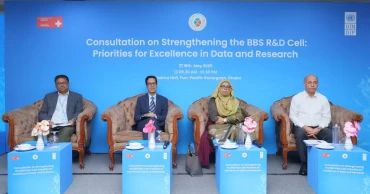
BBS, UNDP move to establish R&D cell for data excellence
The Bangladesh Bureau of Statistics (BBS) and the United Nations Development Programme (UNDP) Bangladesh on Sunday jointly hosted a national consultation in Dhaka to chart a roadmap for building a robust Research and Development (R&D) Cell within the BBS.
Titled “Strengthening the BBS R&D Cell: Priorities for Excellence in Data and Research”, the event was supported by the Embassy of Switzerland and drew participation from over 100 stakeholders representing the government, academia, private sector, and development partners.
The initiative aims to transform the proposed R&D Cell into a centre of excellence that fosters innovation, boosts statistical capacity, and promotes evidence-based policymaking in Bangladesh, said a press release.
Aleya Akter, Secretary of the Statistics and Informatics Division, described the R&D Cell as a “timely and strategic investment,” underscoring the need to engage young researchers and align with global best practices.
Mizanur Rahman, Deputy Director of BBS, said the Cell would enhance methodological integrity and adopt technologies like artificial intelligence to meet the growing demand for quality data at both national and international levels.
Road Safety Act urged to protect pedestrians, cyclists
UNDP Senior Economic Adviser Owais Parray stressed the importance of innovation, saying, “The Cell must become the engine of innovation—testing new tools and ensuring national statistics remain relevant in a rapidly changing world.”
Highlighting the need for inclusive and timely data, UNDP’s Assistant Resident Representative Anowarul Haq called for stronger multi-stakeholder collaboration to realise the Cell’s full potential.
In his concluding remarks, BBS Director General Mohammed Mizanur Rahman reaffirmed the agency’s commitment to establishing a future-ready R&D Cell grounded in strong partnerships.
The consultation emphasised capacity building, inclusive data methodologies, and strategic collaboration as essential elements in modernising Bangladesh’s statistical ecosystem.
1 year ago
Inflation increases slightly in March as non-food prices rise: BBS
Bangladesh’s general point-to-point inflation rate rose slightly to 9.35 percent in March 2025, up from 9.32 percent in February, according to the latest data released by the Bangladesh Bureau of Statistics (BBS).
The slight increase was mainly attributed to a rise in non-food inflation, while food inflation showed a decline.
In March, food inflation fell to 8.93 percent from 9.24 percent in February, while non-food inflation edged up to 9.70 percent from 9.38 percent the previous month.
The data also revealed differing trends between rural and urban areas.
In rural regions, point-to-point inflation dropped to 9.41 percent in March from 9.51 percent in February. Rural food inflation declined to 8.81 percent from 9.15 percent, though non-food inflation rose slightly to 9.97 percent from 9.85 percent.
Paul Krugman slams US tariffs on Bangladeshi clothing
Urban areas experienced an uptick in overall inflation, rising to 9.66 percent in March from 9.34 percent in February.
Urban food inflation declined to 9.18 percent from 9.47 percent, but non-food inflation climbed to 9.95 percent from 9.27 percent.
The 12-month moving average inflation rate from April 2024 to March 2025 stood at 10.26 percent, up from 9.69 percent during the same period a year earlier.
The wage rate index in March was recorded at 8.15 percent, compared to 8.12 percent in February.
1 year ago

Bangladesh’s GDP growth plummets in Q4 of FY 2023-24: BBS
Bangladesh’s GDP growth has sharply declined in the fourth quarter (April-June) of the last financial year 2023-24, according to the Bangladesh Bureau of Statistics (BBS).
The growth was 3.91 per cent, which was 6.88 per cent in the last quarter of the fiscal year 2022-23.
The BBS released the information on Monday.
NBR focuses on boosting low tax-to-GDP ratio as major business figures come under scrutiny
As per the data, the growth in the last quarter of the last financial year has been lower compared to the last quarter of the 2022-23 fiscal year.
According to the calculation of the 4th quarter of the financial year 2023-24, the GDP size at current prices is Tk 13,783,612 million (Tk 13,784 billion) while in the 4th quarter of the financial year 2022-23 it was Tk 12,160,736 million (Tk 12,161 billion).
On the point-to-point basis at constant prices, the growth in the 4th quarter of FY2023-24 was 3.91 percent as against 6.88 percent in the 4th quarter of FY2022-23.
The growth in the first three quarters of FY 2022-23 was 6.25 percent, 7.05 percent and 3.02 percent respectively which in FY 2023-24 stood at 6.04 percent, 4.78 percent and 5.42 percent respectively.
Employment generation takes priority over GDP growth: Planning Adviser Wahiduddin
Agriculture Sector: On a point-to-point basis at constant prices, the agriculture sector grew by 5.27 percent in the 4th quarter of FY2023-24, as against 6.55 per cent in the 4th quarter of FY2022-23.
In the first three quarters of FY 2022-23, the growth of this sector was 0.22 percent, 3.83 percent and 1.92 percent respectively which stood at 0.35 percent, 4.08 percent and 5.16 percent in FY 2023-24 respectively.
Industrial Sector: On a point-to-point basis at constant prices, the industry sector grew at 3.98 percent in the 4th quarter of FY2023-24, as against 10.16 percent in the 4th quarter of FY2022-23.
In the first three quarters of the financial year 2022-23 the growth of this sector was 5.80 percent, 10.55 percent and 6.91 percent respectively which in FY 2023-24 stood at 8.22 percent, 2.91 percent and 6.25 percent respectively.
Services Sector: On a point-to-point basis at constant prices, the service sector grew by 3.67 percent in the 4th quarter of FY2023-24, compared to 4.82 percent in the 4th quarter of FY2022-23.
In the first three quarters of the financial year 2022-23 the growth of this sector was 9.43 percent, 6.37 percent and 1.45 Percent respectively which in FY 2023-24 stood at 5.07 percent, 5.78 percent and 3.81 percent respectively.
1 year ago