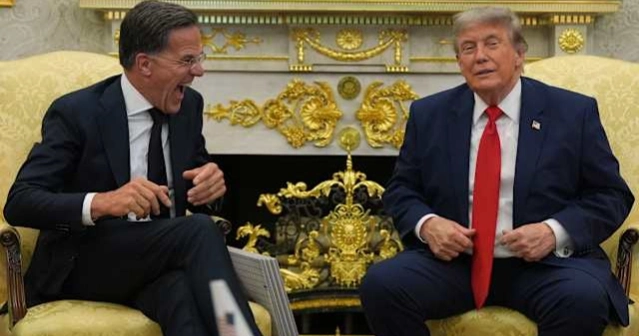
NATO Secretary-General Mark Rutte heads into this week's NATO summit in Turkey facing a new challenge as US President Donald Trump shifts his focus from defense spending to demanding greater "loyalty" from America's allies.
Since taking office nearly two years ago, Rutte has spent much of his time trying to keep the United States committed to the 32-member military alliance. He has often praised Trump in an effort to ease tensions over the president's repeated threats to pull the US out of NATO.
For years, Trump's main complaint was that European allies were not spending enough on defense. At last year's NATO summit, member countries agreed to significantly increase military spending, bringing it closer to US levels as a share of national economic output.
But NATO now faces a different challenge: turning that extra money into stronger military capabilities, especially as European countries grow increasingly concerned about the threat from Russia.
During a White House meeting last month, Rutte presented Trump with a chart titled "The Trump Trillion," highlighting that European allies and Canada have invested $1.2 trillion in defense since 2017.
However, Trump appeared unimpressed. He criticized some NATO allies for refusing to join the US and Israel in military action against Iran, saying he wanted "loyalty" rather than financial contributions.
"We don't need their money. We don't need anything. I just want loyalty," Trump said.
Trump also suggested he might have skipped the upcoming NATO summit if it were not being hosted by Turkish President Recep Tayyip Erdogan, one of the few foreign leaders he has openly praised.
The remarks suggest both Erdogan and Rutte may face an uphill task in keeping the summit focused on alliance unity.
Traditionally, NATO's secretary-general, a role always held by a European, works to build consensus among member states and represent the alliance as a whole.
However, during both of Trump's presidencies, Rutte and his predecessor, Jens Stoltenberg, have devoted much of their efforts to preventing the United States from distancing itself from NATO.
Trump has repeatedly questioned America's commitment to the alliance. He has threatened to withdraw from NATO, suggested pulling US troops out of Europe, and raised doubts about defending allies that fail to spend enough on their militaries. He has also expressed interest in taking control of Greenland, a self-governing territory of NATO member Denmark.
Rutte has responded with careful diplomacy and public praise for Trump.
At the White House last month, he highlighted that increased European defense spending has created tens of thousands of American jobs and generated a $300 billion backlog of European military equipment orders from US manufacturers.
Rutte also gently challenged Trump's claim that NATO had failed to support the US during its military operation against Iran, noting that up to 5,000 American aircraft had flown from bases in Europe before an April ceasefire.
Meanwhile, NATO allies have become increasingly concerned after the Pentagon announced plans to reduce the number of US troops, warships, aircraft and drones available to defend Europe in the event of an attack.
Trump has also given mixed signals about whether US troop levels in Europe will rise or fall.
The uncertainty comes as Russia continues testing Europe's defenses. A study released Thursday said Moscow has increased drone activity near military bases across several European countries.
NATO summits are traditionally designed to demonstrate the alliance's commitment to collective defense under Article 5, which states that an attack on one member is considered an attack on all. The clause has been invoked only once, after the Sept. 11, 2001, attacks in the United States.
Last year's summit in The Hague ended on a positive note after allies agreed to boost defense spending, with Trump describing NATO members as a "nice group of people."
This year's gathering in Turkey is expected to be more difficult.
Rutte has argued that Europe's increased defense investment allows the US to shift more attention toward security challenges posed by China while European allies take greater responsibility for supporting Ukraine.
However, Trump's latest demand for greater "loyalty" from allies has added a new layer of uncertainty ahead of the summit.
In his memoir, former NATO Secretary-General Stoltenberg recalled that Trump nearly derailed the alliance's 2018 summit.
"If an American president says he no longer wishes to defend the other allies and leaves a NATO summit in protest, then the NATO treaty and its security guarantee aren't worth very much," Stoltenberg wrote.