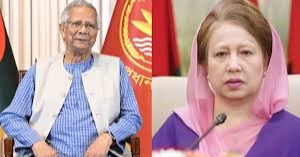
Chief Adviser Prof Muhammad Yunus on Tuesday (December 30, 2025) expressed profound sorrow at the death of three-time former Prime Minister and BNP Chairperson Begum Khaleda Zia, describing her a towering figure in the country’s democratic movement.
"With the sad demise of Begum Khaleda Zia, the nation has lost one of its most significant political guardians. I am deeply saddened and shocked by her death," said Prof Yunus in a condolence message.
He said Khaleda Zia was not merely a political leader, but an inseparable chapter in the history of Bangladesh. “In recognition of her long struggle, historic contributions, and the deep sentiment of the people toward her, the government declared her a person of great national importance earlier this month,” he added.
Chief Adviser calls Council of Advisers to discuss Khaleda Zia’s burial: Fakhrul
The Chief Adviser said that her role in establishing democracy, nurturing a multiparty political culture and safeguarding people’s rights would be remembered with respect.
He said through her firm and uncompromising leadership, the nation repeatedly found inspiration to overcome undemocratic conditions. "Her contributions to the country and its people will remain etched in national memory."
Despite political differences, her long political journey, people-oriented leadership, and unwavering resolve consistently guided the nation toward welfare and democratic values, Prof Yunus said.
"With her death, Bangladesh has lost an experienced, tested, and influential statesperson," he said.
Prof Yunus recalled that Khaleda Zia was the first female Prime Minister of Bangladesh and led the struggle to restore democracy during periods of authoritarian rule.
Entering politics in 1982 following the assassination of her husband, former President, Army Chief, and heroic freedom fighter Ziaur Rahman, she rose from a homemaker to a central figure in national politics.
Her decisive leadership played a pivotal role in ending the nine-year autocratic rule of General Hussain Muhammad Ershad, helping to restore democratic governance in the country.
The Chief Adviser highlighted several of her landmark initiatives, noting that many of her policies carried the nation forward. In particular, the introduction of free education and stipend programs for girls is widely regarded as a milestone in advancing women’s education in Bangladesh.
Read more: Former Prime Minister Khaleda Zia passes away
He said Begum Khaleda Zia’s political career was marked by notable electoral success, having been elected from multiple parliamentary constituencies between 1991 and 2001, and winning all seats she contested in the 2008 general election.
Following her assumption of office in 1991, she laid a strong foundation for the national economy through economic liberalization and reform-oriented policies, the Chief Adviser added.
Prof Yunus described Begum Khaleda Zia as a powerful symbol of struggle and resistance during what he termed the fascist regime of Sheikh Hasina. Her steadfast stance, he said, inspired the nation throughout a prolonged period of political adversity.
He also stated that she became a victim of severe political vendetta due to her success and influence. “She was sentenced to 17 years in prison in what were widely viewed as false and fabricated cases and spent a prolonged period in incarceration,” he said.
The Chief Adviser extended his heartfelt condolences to the bereaved family, as well as to BNP leaders, activists, and supporters across the country.
On this day of irreparable national loss, he called upon citizens to remain calm and patient, and urged everyone to offer prayers and supplications for the departed leader from their respective positions.
Read more: BNP announces 7-day mourning programme